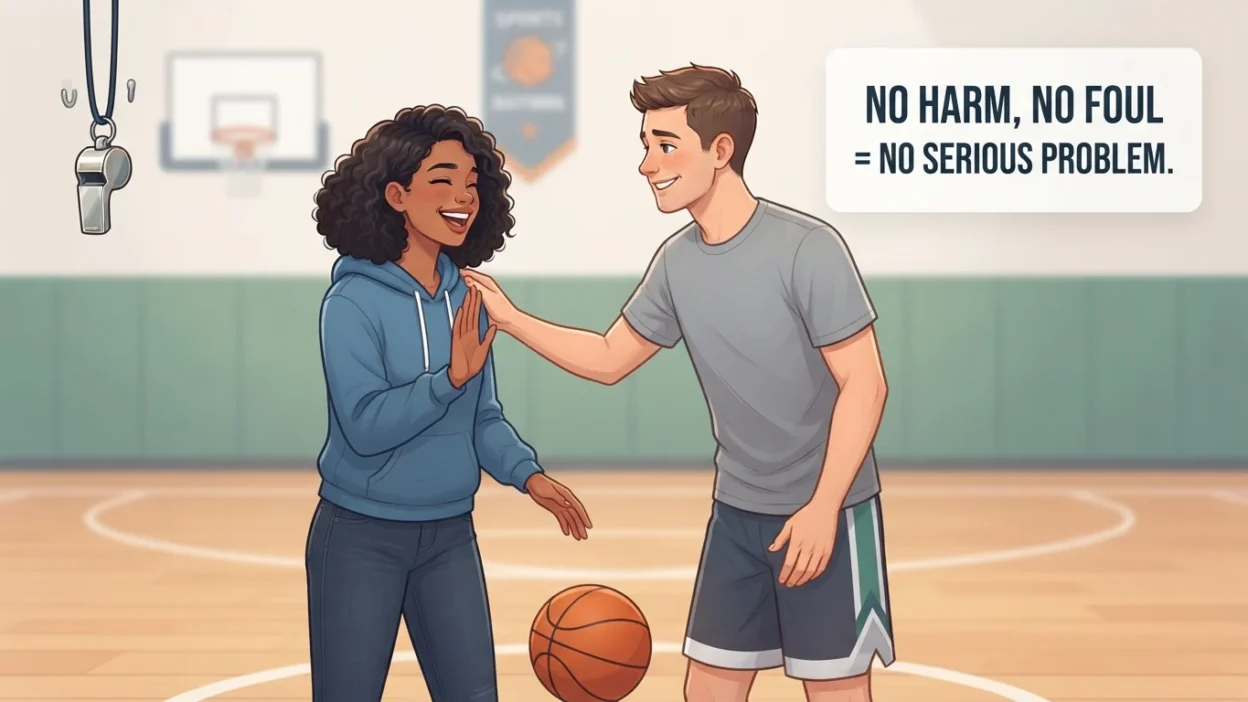
The phrase “no harm, no foul” is a common English expression used when something went wrong, but nobody was seriously hurt or negatively affected, so there is no need to worry or blame anyone. It can also mean that a mistake or minor problem is acceptable because it did not cause any real damage.
For example, if your friend accidentally sends you the wrong file and immediately corrects it, you might say, “No harm, no foul.” You mean that the mistake happened, but it did not create a serious problem. The expression is informal and often used to reassure someone after a small mistake or misunderstanding. It is also associated with sports, especially the idea that an action does not result in a penalty when no foul has occurred. This guide explains the meaning, usage, examples, synonyms, common mistakes, and differences from similar expressions.
Quick Answer
“No harm, no foul” means that a mistake or minor problem caused no serious damage, so there is no reason to be upset or hold anyone responsible. It is similar to “It’s okay” or “No problem.”
Why People Confuse It
The phrase can seem strange if you interpret it literally.
- Harm = injury or damage
- Foul = an unfair or illegal action, especially in sports
But together, “no harm, no foul” has a broader meaning:
Nothing seriously bad happened, so let’s not worry about it.
It is often used after:
- A small mistake
- A misunderstanding
- An accidental inconvenience
- A minor disagreement
- A harmless action
First Word: Harm
Harm means damage, injury, or a negative effect.
For example:
“The mistake caused no harm.”
This means nobody was seriously affected by it.
In the idiom, no harm suggests that the situation did not cause meaningful damage.
Second Word: Foul
A foul can mean an unfair or rule-breaking action, particularly in sports.
For example:
“The referee called a foul.”
The expression “no harm, no foul” comes from the idea that if there was no real harm and no serious wrongdoing, there is no reason to make a big issue of what happened.
In everyday English, however, foul does not usually refer literally to a sports foul.
Comparison Table
| Expression | Meaning | Tone | Example |
|---|---|---|---|
| No harm, no foul | No serious damage, so don’t worry | Informal | You sent the wrong file, but no harm, no foul. |
| No problem | It’s okay | Casual | No problem, you can send it later. |
| It’s all right | Don’t worry about it | Neutral | It’s all right; mistakes happen. |
| No worries | Don’t worry | Casual | No worries, we’re still on time. |
| Let it go | Stop worrying about it | Informal | It was a small mistake—let it go. |
| No big deal | Not important or serious | Casual | It’s no big deal. |
When to Use “No Harm, No Foul”
Use the expression when something slightly wrong happened but there were no serious consequences.
After a small mistake
“Sorry, I accidentally deleted your message.”
“No harm, no foul.”
After a misunderstanding
“I thought you meant tomorrow.”
“That’s okay. No harm, no foul.”
After a minor inconvenience
“The restaurant gave us the wrong order, but they fixed it quickly.”
“No harm, no foul.”
When forgiving someone
“You forgot to call me, but no harm, no foul.”
It can communicate that you are not holding the mistake against the person.
Examples of “No Harm, No Foul”
- You made a small mistake, but no harm, no foul.
- I misunderstood your message, but no harm, no foul.
- You accidentally took my pen. No harm, no foul.
- We arrived a little late, but no harm, no foul.
- The plan changed at the last minute, but no harm, no foul.
- You forgot to send the email, but no harm, no foul.
- I thought the meeting was at three. No harm, no foul.
- She made a mistake, but no harm, no foul.
- The order was wrong, but they corrected it. No harm, no foul.
- We missed the first bus, but no harm, no foul—we caught the next one.
- You didn’t mean to upset me. No harm, no foul.
- The information was slightly incorrect, but no harm, no foul.
Common Mistakes
Mistake 1: Thinking it means nothing happened
It does not mean that absolutely nothing happened.
Something usually did happen, but it did not cause serious consequences.
“I made a mistake, but no harm, no foul.”
The mistake existed; it simply wasn’t serious.
Mistake 2: Using it for serious harm
The expression is generally inappropriate when someone has suffered serious injury, major loss, or significant damage.
For serious situations, a more appropriate response would be an apology or acknowledgment of the harm.
Mistake 3: Thinking “foul” must refer to sports
The expression has roots in sports terminology, but today it is commonly used as a general idiom.
Mistake 4: Assuming it is very formal
“No harm, no foul” is informal and conversational.
In formal writing, alternatives such as:
“No significant harm was caused.”
or:
“The issue had no serious consequences.”
may be more appropriate.
Memory Trick
Think:
No harm + no foul = No real problem.
An easy equivalent is:
“It’s okay; don’t worry about it.”
So if a small mistake happens and everything is fine afterward, you can say:
“No harm, no foul.”
American vs British English
“No harm, no foul” is used in both American and British English.
However, it is especially recognizable in American informal English. British speakers may also use it, although expressions such as “no harm done” can sound more natural in some situations.
For example:
“Sorry I broke the arrangement.”
“No harm done.”
This has a very similar meaning.
Similar Words
No Harm Done
Probably the closest alternative.
“Sorry I interrupted you.”
“No harm done.”
No Problem
A very common casual alternative.
“Sorry I’m late.”
“No problem.”
No Worries
Used to reassure someone.
“Sorry about that.”
“No worries.”
No Big Deal
Means the issue is not important or serious.
“I forgot the book, but it’s no big deal.”
It’s All Good
Very informal and reassuring.
“Sorry about the misunderstanding.”
“It’s all good.”
Final Verdict
“No harm, no foul” means a mistake or minor problem happened, but it caused no serious damage, so there is no need to be upset or hold a grudge. It is usually used in friendly, informal conversations.
The phrase is especially useful when you want to reassure someone after a small mistake. Similar expressions include “no problem,” “no worries,” “no harm done,” and “no big deal.”
FAQs
1. What does “no harm, no foul” mean in simple English?
It means “Something went slightly wrong, but it’s okay because nobody was seriously affected.”
2. Is “no harm, no foul” an idiom?
Yes. It is a common informal English idiom.
3. Is “no harm, no foul” positive?
Usually, yes. It is often used to reassure someone and show that you are not upset about a minor mistake.
4. What is another way to say “no harm, no foul”?
You can say:
- No harm done
- No problem
- No worries
- It’s all good
- No big deal
5. Can I use “no harm, no foul” after an apology?
Yes.
“Sorry I forgot to call.”
“No harm, no foul.”
6. Is “no harm, no foul” formal?
No. It is generally informal and conversational.
7. Does “no harm, no foul” mean “I forgive you”?
It can imply that you are not holding a minor mistake against someone, although it does not literally mean “I forgive you.”
Conclusion
The idiom “no harm, no foul” is a friendly way of saying that a mistake or minor problem did not cause serious consequences. It tells the other person that there is no need to worry, apologize excessively, or feel guilty about what happened.
Although the phrase contains words associated with injury and sports, its everyday meaning is much simpler: “It happened, but everything is okay.” Use it mainly in casual conversations when the situation is minor and no meaningful harm has occurred.
Remember This
No harm, no foul = No serious problem, so don’t worry about it.
“Sorry I made a mistake.”
“No harm, no foul.”
= “It’s okay. Don’t worry about it.”

Baylor Wylder is a culture and lifestyle blogger with a modern frontier perspective.
He writes about creativity, independence, and building a life with purpose.
His work blends reflection, ambition, and contemporary style.