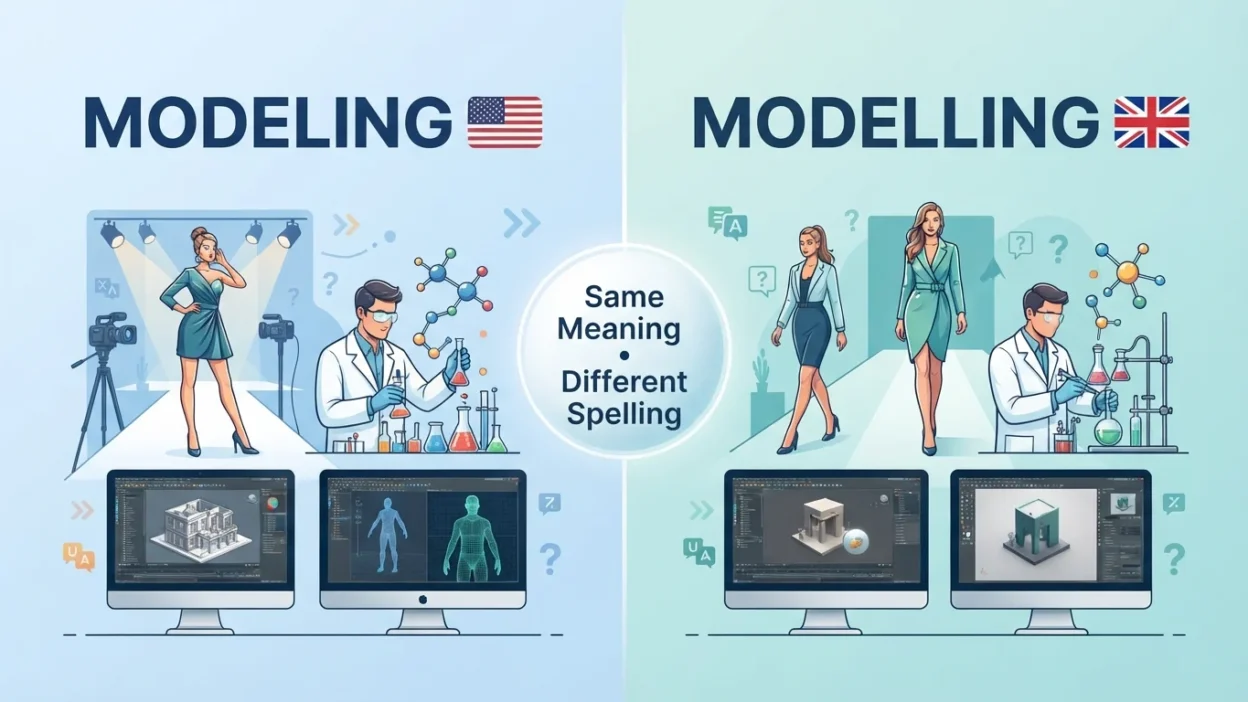
“Modeling” and “modelling” have the same meaning. The only real difference is which variety of English you are using. Modeling is the standard spelling in American English, while modelling is the standard spelling in British English and is also common in other varieties that follow British spelling conventions.
Both forms can refer to working as a fashion model, creating a representation of something, or demonstrating how something works. For example, “She is modeling for a fashion brand” and “She is modelling for a fashion brand” mean exactly the same thing. The same spelling difference appears with modeled/modelling and modeler/modeller, although the exact preferred forms can vary by context. Understanding this small difference is useful when writing essays, articles, assignments, or professional content because consistency matters more than choosing one spelling universally.
Quick Answer
Modeling is the American English spelling, while modelling is the British English spelling. Both mean the same thing. Use modeling for US English and modelling for UK English.
Why People Confuse It
The confusion comes from a common spelling difference between American and British English.
American English often uses one “l” before the ending:
modeling
modeled
British English generally doubles the l:
modelling
modelled
This is similar to other spelling differences:
- traveling vs travelling
- canceled vs cancelled
- labeled vs labelled
So the difference is mainly about spelling conventions, not meaning.
First Word: Modeling
Modeling is the standard American English spelling.
It can have several meanings depending on context.
Fashion
“She is modeling for a clothing brand.”
Here, modeling means working as a fashion model.
Demonstrating
“The teacher is modeling the correct pronunciation.”
Here, it means demonstrating how something should be done.
Creating a representation
“Scientists are modeling climate patterns.”
Here, modeling means creating a model or representation of something.
Second Word: Modelling
Modelling is the standard British English spelling of the same word.
It has exactly the same meanings:
“She is modelling for a clothing brand.”
“The teacher is modelling the correct pronunciation.”
“Scientists are modelling climate patterns.”
The pronunciation and meaning are essentially the same.
Comparison Table
| Feature | Modeling | Modelling |
|---|---|---|
| English variety | American English | British English |
| Meaning | Same | Same |
| Fashion | Yes | Yes |
| Demonstrating | Yes | Yes |
| Creating a model | Yes | Yes |
| Standard spelling | US | UK |
| Example | She is modeling. | She is modelling. |
When to Use Each
Use “Modeling” in American English
If you are following American English spelling, write:
modeling
Examples:
- Modeling career
- Modeling agency
- 3D modeling
- Data modeling
- Fashion modeling
Use “Modelling” in British English
If you are following British English spelling, write:
modelling
Examples:
- Modelling career
- Modelling agency
- 3D modelling
- Data modelling
- Fashion modelling
Most Important Rule
Do not mix spelling systems unnecessarily.
If your article uses British English, use modelling consistently.
If your article uses American English, use modeling consistently.
Examples of Modeling vs Modelling
American English
- She started modeling when she was young.
- He is interested in 3D modeling.
- The company uses computer modeling.
- She is modeling a new collection.
- The software is useful for data modeling.
- The teacher is modeling the correct technique.
British English
- She started modelling when she was young.
- He is interested in 3D modelling.
- The company uses computer modelling.
- She is modelling a new collection.
- The software is useful for data modelling.
- The teacher is modelling the correct technique.
The meanings of these pairs are the same.
Common Mistakes
Mistake 1: Thinking one spelling is wrong
❌ “Modelling is incorrect.”
Not necessarily.
Modelling is correct in British English.
Likewise:
❌ “Modeling is incorrect.”
Not necessarily.
Modeling is correct in American English.
Mistake 2: Mixing US and UK spelling
For example:
“She is modelling and her favorite color is blue.”
This mixes British modelling with American favorite.
If you’re using British English:
“She is modelling and her favourite colour is blue.”
If you’re using American English:
“She is modeling and her favorite color is blue.”
Mistake 3: Thinking the meaning changes
The extra l does not change the meaning.
modeling = modelling
The difference is spelling convention.
Mistake 4: Confusing “modeling” with only fashion
Modeling/modelling is not limited to fashion.
It can also refer to:
- Mathematics
- Science
- Computers
- Data
- Education
- Business
- Engineering
Memory Trick
Remember:
🇺🇸 American = Modeling
🇬🇧 British = Modelling
A simple way to remember the British spelling is:
British English likes the double “L” in modelling.
You can also connect it with:
traveling → travelling
canceled → cancelled
modeling → modelling
American vs British English
This is where the main difference lies.
American English
American English usually prefers:
- modeling
- modeled
- travelling → traveling
- canceled
British English
British English generally prefers:
- modelling
- modelled
- travelling
- cancelled
So if you’re writing for a British-English audience, modelling is the appropriate spelling.
If you’re writing for an American-English audience, use modeling.
Similar Words
Model
A representation, example, or person who displays clothing or products.
“She is a professional model.”
Modeling / Modelling
The activity of working as a model or creating/demonstrating a model.
“She is modelling for a fashion brand.”
Modeled / Modelled
The past-tense and past-participle forms.
US: “She modeled for the brand.”
UK: “She modelled for the brand.”
Modeler / Modeller
A person who creates models, although the preferred spelling varies by English variety.
Final Verdict
Modeling and modelling are both correct. They have the same meaning; the difference is simply regional spelling. Modeling is preferred in American English, while modelling is preferred in British English.
If you are writing for a Pakistani, British, or other British-English educational context, modelling will generally be the more familiar spelling. If you’re following American English, choose modeling. Most importantly, choose one spelling system and remain consistent throughout your writing.
FAQs
1. Is it modeling or modelling?
Both are correct.
- Modeling = American English
- Modelling = British English
2. Which spelling is used in British English?
Modelling is the standard British spelling.
3. Which spelling is used in American English?
Modeling is the standard American spelling.
4. Do modeling and modelling have different meanings?
No. They have the same meaning.
5. Is “modelling” wrong in American English?
It is not necessarily incomprehensible, but modeling is the standard American spelling.
6. Is “modeling” wrong in British English?
It is understood, but modelling is the standard British spelling.
7. Which spelling should I use in an English essay?
Follow the variety of English your school, teacher, exam board, or publication requires. If you’re using British English, choose modelling.
Conclusion
The difference between modeling and modelling is a spelling difference rather than a vocabulary difference. Both words describe the same activities, whether you’re talking about fashion, science, computer models, data, or demonstrating a particular technique.
The easiest rule is to remember the regional spelling: modeling = American English, while modelling = British English. Whichever form you choose, consistency is the key. If your writing follows British English, keep the double l; if it follows American English, use the single l.
Remember This
🇺🇸 Modeling = American English
🇬🇧 Modelling = British English
Same meaning. Different spelling.

Miller Rhodes is an American nonfiction writer focused on personal growth and modern entrepreneurship.
His work blends thoughtful analysis with practical strategies for navigating today’s digital world.
He writes to help readers think clearer, act smarter, and build meaningful success.