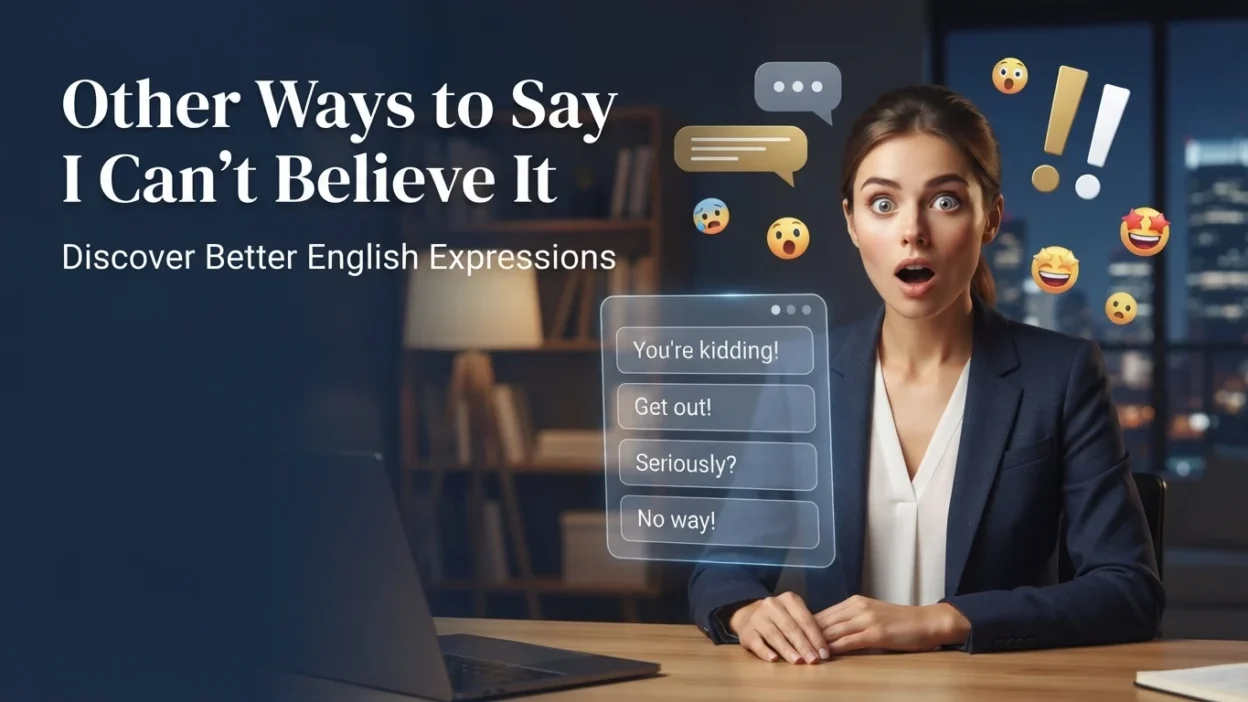
When something is shocking, surprising, unbelievable, or simply hard to accept, “I can’t believe it” is one of the most common expressions in English. Native speakers use it in everyday conversations, text messages, social media posts, emails, stories, and emotional reactions.
However, repeating the same phrase can make your English sound predictable. Depending on the situation, you may want to express surprise, disbelief, amazement, shock, excitement, confusion, or disappointment more precisely. The right alternative can also change the tone from casual and friendly to dramatic, humorous, emotional, or formal.
Quick answer: Some natural alternatives to “I can’t believe it” include “I’m stunned,” “I’m speechless,” “This is unbelievable,” “No way!” “I’m in shock,” “I can hardly believe it,” and “You’ve got to be kidding me.” The best choice depends on your emotion, audience, and situation.
What Are Other Ways to Say I Can’t Believe It?
1. I’m stunned
Meaning: “I’m stunned” means you are extremely surprised or shocked and temporarily do not know what to say.
Usage: Use it when unexpected news has a strong emotional effect. It works well in both spoken and written English.
Example: “I’m stunned that she won the competition.”
Tip: “Stunned” usually suggests stronger surprise than ordinary expressions such as “I’m surprised.”
2. I’m speechless
Meaning: “I’m speechless” means something has affected you so strongly that you do not know what to say.
Usage: It can express shock, amazement, happiness, admiration, or even anger.
Example: “You bought me a new laptop? I’m speechless!”
Tip: The expression does not always indicate something negative. Context determines whether the emotion is positive or negative.
3. This is unbelievable
Meaning: “This is unbelievable” means something seems extremely difficult to believe.
Usage: Use it for surprising events, remarkable achievements, unexpected news, or frustrating situations.
Example: “You finished the entire project in one day? This is unbelievable!”
Tip: Tone matters. Said happily, it can express amazement; said angrily, it can express frustration.
4. No way!
Meaning: “No way!” is a short informal expression of strong surprise or disbelief.
Usage: It is especially common in conversations, text messages, and casual social situations.
Example: “No way! You met your favorite actor?”
Tip: Avoid it in formal business writing because it is highly conversational.
5. I’m in shock
Meaning: “I’m in shock” means you are extremely surprised, upset, or emotionally affected by something unexpected.
Usage: Use it when an event has a powerful emotional impact.
Example: “I’m still in shock after hearing the news.”
Tip: The phrase can describe serious situations, so it is stronger than simply saying “I’m surprised.”
6. I can hardly believe it
Meaning: This means something is so surprising that accepting it as true is difficult.
Usage: It is useful for both positive and negative surprises.
Example: “I can hardly believe it—we finally reached our goal.”
Tip: This is one of the closest natural alternatives to “I can’t believe it” and works in many situations.
7. You’ve got to be kidding me
Meaning: This means you strongly suspect that something cannot be true or that someone must be joking.
Usage: It is informal and often expresses disbelief, annoyance, or surprise.
Example: “You’ve got to be kidding me. The meeting was canceled again?”
Tip: Because it can sound irritated, use it carefully when speaking to people you do not know well.
How Can You Express Surprise or Amazement?
1. I’m amazed
Meaning: “I’m amazed” means you are very surprised, often because something is impressive or extraordinary.
Usage: Use it for positive or neutral reactions to remarkable events.
Example: “I’m amazed by how quickly she learned the language.”
Tip: “Amazed” often carries a positive feeling, making it useful for compliments.
2. I’m blown away
Meaning: “I’m blown away” means you are extremely impressed or surprised.
Usage: It is informal and common in modern conversational English.
Example: “I’m completely blown away by your performance.”
Tip: This expression is particularly natural when something exceeds your expectations.
3. That’s incredible!
Meaning: “That’s incredible!” expresses strong admiration, surprise, or excitement.
Usage: Use it when someone tells you impressive or unexpected news.
Example: “You climbed the mountain in one day? That’s incredible!”
Tip: It is versatile and generally positive.
4. That’s amazing!
Meaning: “That’s amazing!” shows strong positive surprise or admiration.
Usage: It works naturally in conversations, messages, comments, and informal writing.
Example: “You got the job? That’s amazing!”
Tip: It is one of the safest alternatives when you want to sound enthusiastic without sounding dramatic.
5. I’m amazed by this
Meaning: This phrase directly identifies the thing causing your surprise or admiration.
Usage: Follow “by” with a noun or noun phrase.
Example: “I’m amazed by this incredible transformation.”
Tip: “Amazed by” is particularly useful in descriptive writing because it clearly connects the emotion to its cause.
6. I’m blown away by this
Meaning: This means something has made a very strong impression on you.
Usage: Use “by” to introduce the person, thing, or event responsible for the reaction.
Example: “I’m blown away by the quality of this work.”
Tip: This is casual and enthusiastic, so it is better suited to friendly or informal communication.
7. I never expected this
Meaning: This means the event is surprising because you did not predict or anticipate it.
Usage: Use it when the main idea is unexpectedness rather than total disbelief.
Example: “I never expected this. Thank you so much!”
Tip: It can sound emotional without being overly dramatic.
What Can You Say When You Are in Disbelief?
1. I don’t believe it
Meaning: “I don’t believe it” directly communicates that you are having difficulty accepting something as true.
Usage: It is close in meaning to “I can’t believe it” but can sometimes sound more skeptical.
Example: “I don’t believe it. He actually resigned?”
Tip: Use your tone carefully because the expression can suggest that you doubt the speaker.
2. Are you serious?
Meaning: “Are you serious?” asks whether someone genuinely means what they have said.
Usage: It is common when surprising information sounds difficult to accept.
Example: “Are you serious? They gave you the promotion?”
Tip: It can express excitement as well as disbelief, depending on your voice.
3. Really?
Meaning: “Really?” is a very short way to express surprise, doubt, or interest.
Usage: It is appropriate in casual conversations and messages.
Example: “Really? You’re moving to Canada?”
Tip: Because it is so short, facial expression and tone are important.
4. Is this really happening?
Meaning: This question expresses disbelief about an event that is currently taking place.
Usage: Use it when reality feels surprising or almost unreal.
Example: “Is this really happening? We actually won the final!”
Tip: It is especially effective for major life events, celebrations, or unexpected moments.
5. This can’t be real
Meaning: This expression says that something seems too surprising, strange, or extraordinary to be true.
Usage: It is informal and strongly emotional.
Example: “This can’t be real. We found the missing documents!”
Tip: Use it when your reaction is stronger than ordinary surprise.
6. I refuse to believe it
Meaning: This means you strongly reject the idea that something is true.
Usage: It can be serious or playful depending on context.
Example: “I refuse to believe it. There must be some mistake.”
Tip: It is stronger and more dramatic than “I don’t believe it.”
7. I’m having a hard time believing this
Meaning: This means you are struggling to accept unexpected information.
Usage: It is useful when you want to sound less dramatic and more thoughtful.
Example: “I’m having a hard time believing this happened so quickly.”
Tip: This expression works well in serious conversations because it sounds measured rather than explosive.
What Are Casual and Conversational Alternatives?
1. No kidding!
Meaning: “No kidding!” can express surprise or agreement that something is remarkable.
Usage: It is informal and commonly used in friendly conversation.
Example: “He finished the race in under three hours.” “No kidding!”
Tip: Context is important because “no kidding” can also mean “I’m serious.”
2. Seriously?
Meaning: “Seriously?” asks whether surprising information is actually true.
Usage: Use it in informal speech, texting, and casual conversations.
Example: “Seriously? You already finished the whole book?”
Tip: It can sound excited, skeptical, or annoyed depending on tone.
3. You’re kidding!
Meaning: “You’re kidding!” expresses disbelief because you think the information sounds impossible or surprising.
Usage: It is conversational and often friendly.
Example: “You’re kidding! You got front-row tickets?”
Tip: It is generally less confrontational than “You’ve got to be kidding me.”
4. Get out of here!
Meaning: In casual American English, this can mean “I don’t believe you” or “That’s incredibly surprising.”
Usage: Use it only when the context clearly supports a playful meaning.
Example: “Get out of here! You actually met the president?”
Tip: Literally, the phrase can mean “leave,” so tone and context are essential.
5. You’re joking!
Meaning: “You’re joking!” means you think someone must be joking because their statement is surprising.
Usage: It is informal and natural in friendly conversation.
Example: “You’re joking! They offered you the position?”
Tip: In British English, “You’re joking!” is especially natural in conversational situations.
6. Come on!
Meaning: “Come on!” can express disbelief, especially when you think something is unreasonable or difficult to accept.
Usage: It is informal and depends heavily on tone.
Example: “Come on! You expect me to believe that?”
Tip: Because it can sound impatient, avoid it when you want a calm or respectful tone.
7. What?!
Meaning: “What?!” is an extremely short reaction to unexpected information.
Usage: It is common in speech, texting, and informal dialogue.
Example: “What?! They canceled the entire event?”
Tip: In formal writing, replace it with a complete sentence such as “I’m surprised to hear that.”
What Are Stronger Ways to Express Shock?
1. I’m absolutely shocked
Meaning: This means something has caused an intense feeling of surprise.
Usage: Use it for serious or highly unexpected news.
Example: “I’m absolutely shocked by what happened.”
Tip: “Absolutely” intensifies the adjective “shocked,” making the reaction stronger.
2. I’m completely speechless
Meaning: This means you are so shocked, impressed, or emotional that you cannot find words.
Usage: It is useful for dramatic emotional reactions.
Example: “After seeing the final results, I was completely speechless.”
Tip: This can express both positive amazement and negative shock.
3. I’m still trying to process this
Meaning: This means you need time to understand or emotionally accept unexpected information.
Usage: It is especially natural after major or emotional events.
Example: “I’m still trying to process this. Everything happened so quickly.”
Tip: This phrase sounds thoughtful and modern rather than overly dramatic.
4. I never saw this coming
Meaning: This means you did not anticipate the event at all.
Usage: Use it when an outcome is very different from what you expected.
Example: “I never saw this coming. I thought they were going to reject the proposal.”
Tip: This phrase focuses on unexpectedness rather than whether you believe the event is true.
5. This is beyond belief
Meaning: This means something seems so extraordinary that it is difficult to believe.
Usage: It can describe amazing, shocking, or frustrating situations.
Example: “The amount of support we received is beyond belief.”
Tip: The phrase is stronger and more dramatic than “This is surprising.”
6. I’m at a loss for words
Meaning: This means you do not know what to say because of a strong emotional reaction.
Usage: It works especially well after emotional, impressive, or shocking events.
Example: “I’m at a loss for words after seeing what you created.”
Tip: It is more polished than many casual alternatives and can fit formal or semi-formal writing.
7. I don’t even know what to say
Meaning: This means an event has surprised or affected you so strongly that you cannot immediately respond.
Usage: It is common in emotional conversations.
Example: “I don’t even know what to say. This is incredible.”
Tip: It sounds natural because it focuses on your immediate reaction.
Which Phrase Should You Use in Different Situations?
1. For happy surprises
Meaning: Happy surprises call for expressions that communicate excitement, joy, or admiration rather than fear or disbelief.
Usage: Choose phrases such as “That’s amazing!” or “I’m blown away!”
Example: “You got the scholarship? That’s amazing!”
Tip: Positive wording prevents your reaction from sounding worried or negative.
2. For shocking news
Meaning: Shocking news usually requires stronger language than ordinary surprise.
Usage: “I’m stunned,” “I’m in shock,” and “I’m speechless” are suitable choices.
Example: “I’m stunned by the announcement.”
Tip: Avoid overly casual expressions when the subject is serious or sensitive.
3. For good news
Meaning: Good news often deserves an enthusiastic response that clearly communicates happiness.
Usage: Use “That’s incredible!”, “I’m amazed!”, or “I can hardly believe it!”
Example: “You passed the exam with the highest score? I can hardly believe it!”
Tip: Add a positive follow-up to make your response warmer: “That’s incredible! Congratulations!”
4. For bad news
Meaning: Bad news may require expressions of shock, sadness, or difficulty accepting what happened.
Usage: “I’m so sorry,” “I’m stunned,” or “I’m having a hard time believing this” may be more appropriate.
Example: “I’m having a hard time believing this. I’m so sorry for what happened.”
Tip: Consider the other person’s feelings before using humorous expressions.
5. For texting and social media
Meaning: Digital conversations usually allow short, expressive phrases.
Usage: “No way!”, “Seriously?!”, “What?!”, and “You’re kidding!” are common choices.
Example: “No way! You actually won?”
Tip: Emojis and punctuation can reinforce the intended emotion, but avoid excessive punctuation in professional communication.
6. For professional writing
Meaning: Professional communication usually requires controlled and respectful expressions.
Usage: Consider “I was surprised to learn,” “I was astonished to hear,” or “This was unexpected.”
Example: “I was surprised to learn that the schedule had changed.”
Tip: Avoid slang such as “No way!” or “Get out of here!” in formal emails and reports.
7. For storytelling and creative writing
Meaning: Storytelling benefits from language that shows emotion and helps readers experience the character’s reaction.
Usage: Combine direct dialogue with descriptive details.
Example: “She stared at the letter, unable to speak. ‘I’m speechless,’ she whispered.”
Tip: Instead of repeatedly telling readers that a character cannot believe something, show the reaction through actions, dialogue, and description.
Placement & Grammar Rules
| Synonym/Phrase | Sentence Position/Placement | Tone/Formality | Example Sentence | Common Mistake |
| I’m stunned | Usually at the beginning | Neutral to strong | I’m stunned by the news. | Saying “I’m stunned of” |
| I’m speechless | Usually at the beginning or after the subject | Neutral | I’m speechless after hearing that. | Using “speechless” as a verb |
| This is unbelievable | Beginning or standalone | Casual to neutral | This is unbelievable! | Assuming it always means something positive |
| No way! | Standalone reaction | Very casual | No way! You won? | Using it in formal writing |
| I’m in shock | Beginning or after subject | Neutral to strong | I’m still in shock. | Confusing “shock” with ordinary surprise |
| I can hardly believe it | Standalone or sentence beginning | Neutral | I can hardly believe it happened. | Omitting “can” |
| You’re kidding me | Usually standalone | Casual | You’re kidding me! | Using it with a serious tone accidentally |
| I’m amazed | Beginning or middle | Neutral | I’m amazed by your progress. | Saying “amazed of” |
| I’m blown away | Beginning or middle | Casual | I’m blown away by the results. | Using it in highly formal writing |
| Are you serious? | Standalone question | Casual | Are you serious? | Treating it as formal language |
| I never saw this coming | Usually beginning or standalone | Casual to neutral | I never saw this coming. | Using it for predictable events |
| I’m at a loss for words | Beginning or standalone | Neutral | I’m at a loss for words. | Adding unnecessary prepositions |
Common Mistakes When Saying “I Can’t Believe It”
1. Using casual slang in formal writing
Meaning: Some expressions are grammatically correct but unsuitable for professional contexts.
Usage: Avoid “No way!”, “You’re kidding!”, and “Get out of here!” in formal emails, academic papers, and business reports.
Example: Casual: “No way! The deadline changed!” Formal: “I was surprised to learn that the deadline had changed.”
Tip: Always match the expression to your audience.
2. Confusing surprise with disbelief
Meaning: Surprise means something was unexpected, while disbelief suggests difficulty accepting something as true.
Usage: Use “I’m surprised” when the information is unexpected and “I don’t believe it” when you genuinely doubt or struggle to accept it.
Example: “I’m surprised he arrived early” is different from “I don’t believe he actually arrived.”
Tip: Think about whether your reaction is “I did not expect this” or “I cannot accept that this is true.”
3. Overusing “unbelievable”
Meaning: “Unbelievable” is powerful, but repeated use can make your writing less precise.
Usage: Replace it with specific alternatives when you know the exact emotion.
Example: Instead of “The result was unbelievable,” write “The result left everyone speechless.”
Tip: Specific emotional vocabulary usually creates clearer communication.
4. Choosing an expression that sounds too dramatic
Meaning: Some expressions imply extreme shock even when the situation is minor.
Usage: Match intensity to the event.
Example: “I’m in shock” may sound excessive if a friend simply changes a lunch time.
Tip: For small surprises, use “Really?”, “Oh, I didn’t expect that,” or “That’s surprising.”
5. Ignoring the speaker’s tone
Meaning: Several expressions can communicate different emotions depending on voice and context.
Usage: “Seriously?” can sound excited, doubtful, angry, or curious.
Example: “Seriously? You got the job!” sounds excited, while “Seriously? You forgot again?” sounds annoyed.
Tip: In writing, add context when the intended emotion may be unclear.
6. Using “I can’t believe” without considering context
Meaning: “I can’t believe” can communicate excitement, anger, sadness, admiration, or disbelief.
Usage: Add context when precision matters.
Example: “I can’t believe we won!” clearly expresses excitement.
Tip: A short follow-up can remove ambiguity: “I can’t believe we won—I’m so happy!”
7. Repeating the same phrase too often
Meaning: Repetition can make speech and writing sound limited.
Usage: Alternate between expressions according to the specific emotion.
Example: Use “I’m stunned” for shock, “That’s amazing!” for admiration, and “I never saw this coming” for unexpected events.
Tip: Do not replace every occurrence mechanically. Choose the phrase that best matches the meaning.
Practical Examples in Real English
1. In everyday conversation
Meaning: Everyday conversations favor short, natural expressions.
Usage: Choose phrases that are easy to say spontaneously.
Example: “No way! You’re moving abroad?” “Seriously? I had no idea!”
Tip: Short expressions often sound more natural than long explanations in casual speech.
2. In a text message
Meaning: Texting allows highly conversational reactions.
Usage: “OMG,” “No way!”, “Seriously?!”, and “You’re kidding!” may work among friends.
Example: “You won the tickets? No way!!!”
Tip: Keep your wording appropriate to the relationship and avoid excessive punctuation in professional texts.
3. In a friendly email
Meaning: Friendly emails can be warm without being overly informal.
Usage: Use “I can hardly believe it,” “That’s wonderful,” or “I’m amazed.”
Example: “I can hardly believe it! Congratulations on your achievement.”
Tip: Friendly does not necessarily mean slang-heavy.
4. In a workplace conversation
Meaning: Workplace speech often requires a balance between natural conversation and professionalism.
Usage: “That’s surprising,” “I was not expecting that,” or “I’m surprised to hear that” are safe choices.
Example: “I was surprised to hear that the meeting was moved to Friday.”
Tip: Professional surprise is usually clearer when you state the specific information that surprised you.
5. In an academic context
Meaning: Academic writing generally avoids emotional conversational expressions.
Usage: Use objective wording such as “This result was unexpected” or “The findings were surprising.”
Example: “The findings were unexpected and differed significantly from the initial hypothesis.”
Tip: Academic writing should explain why a result is surprising rather than simply declaring it unbelievable.
6. In a story
Meaning: Fiction and personal storytelling can use emotional dialogue to make scenes vivid.
Usage: Combine speech with physical reactions and descriptive details.
Example: “He read the message twice. ‘This can’t be real,’ he said, staring at the screen.”
Tip: Showing a character’s reaction can be more effective than repeatedly using “I can’t believe it.”
7. In social media captions
Meaning: Social media captions often use concise, emotional language.
Usage: Choose expressions that match the mood of the post.
Example: “I’m still speechless. What an unforgettable day!”
Tip: For positive events, phrases such as “I’m blown away” and “I can hardly believe it” can create an enthusiastic tone without sounding forced.
FAQs
1. What is the most natural way to say “I can’t believe it”?
Meaning: The most natural alternative depends on the situation.
Usage: “I can hardly believe it,” “I’m stunned,” “I’m speechless,” and “This is unbelievable” are broadly useful.
Example: “I can hardly believe it—we finally finished the project.”
Tip: For ordinary surprise, “I can hardly believe it” is a particularly close alternative.
2. What is a slang way to say “I can’t believe it”?
Meaning: Slang and casual expressions make a reaction sound more conversational.
Usage: Try “No way!”, “You’re kidding!”, “Seriously?!”, or “You’ve got to be kidding me!”
Example: “No way! You actually met him?”
Tip: These expressions are best for friends, casual conversations, texting, and informal dialogue.
3. How do I say “I can’t believe it” professionally?
Meaning: Professional language should communicate surprise without sounding overly emotional or informal.
Usage: Try “I was surprised to learn,” “This was unexpected,” or “I was astonished to hear.”
Example: “I was surprised to learn that the project had been completed ahead of schedule.”
Tip: In professional writing, explain the surprising fact rather than relying on an emotional exclamation.
4. What can I say instead of “I can’t believe it” when I am happy?
Meaning: Positive surprise is best expressed with enthusiastic but clearly positive language.
Usage: Use “That’s amazing!”, “That’s incredible!”, “I’m thrilled!”, or “I can hardly believe it!”
Example: “You got the scholarship? That’s incredible!”
Tip: Adding “Congratulations!” can make your response warmer and clearer.
5. What can I say instead of “I can’t believe it” when I am shocked?
Meaning: Strong shock requires stronger expressions.
Usage: “I’m stunned,” “I’m in shock,” “I’m speechless,” and “I never saw this coming” are suitable.
Example: “I’m stunned. I never saw this coming.”
Tip: Consider the seriousness of the event before using highly dramatic language.
6. Is “I can’t believe this” grammatically correct?
Meaning: Yes. “I can’t believe this” is grammatically correct and very common.
Usage: Use “this” when referring to a situation, event, statement, or circumstance.
Example: “I can’t believe this is happening.”
Tip: “I can’t believe it” often refers to a particular fact or event, while “I can’t believe this” can emphasize the situation itself.
7. What is the difference between “I can’t believe it” and “I don’t believe it”?
Meaning: Both can express disbelief, but their emphasis can differ.
Usage: “I can’t believe it” often expresses strong surprise or amazement, while “I don’t believe it” can sound more like doubt or rejection of a claim.
Example: “I can’t believe it! We won!” expresses joyful surprise. “I don’t believe it. That explanation makes no sense” expresses skepticism.
Tip: Choose “I can’t believe it” for emotional surprise and “I don’t believe it” when you are questioning whether something is true.
Final Thoughts
“I can’t believe it” is a flexible English expression, but you have many alternatives for showing different shades of surprise and disbelief. “I’m stunned,” “I’m speechless,” “That’s amazing,” “No way,” and “I can hardly believe it” each create a slightly different impression.
The key is to match the phrase with your emotion, audience, and level of formality. Once you understand these differences, your conversations and writing can sound more precise, expressive, and natural.

Baylor Wylder is a culture and lifestyle blogger with a modern frontier perspective.
He writes about creativity, independence, and building a life with purpose.
His work blends reflection, ambition, and contemporary style.