
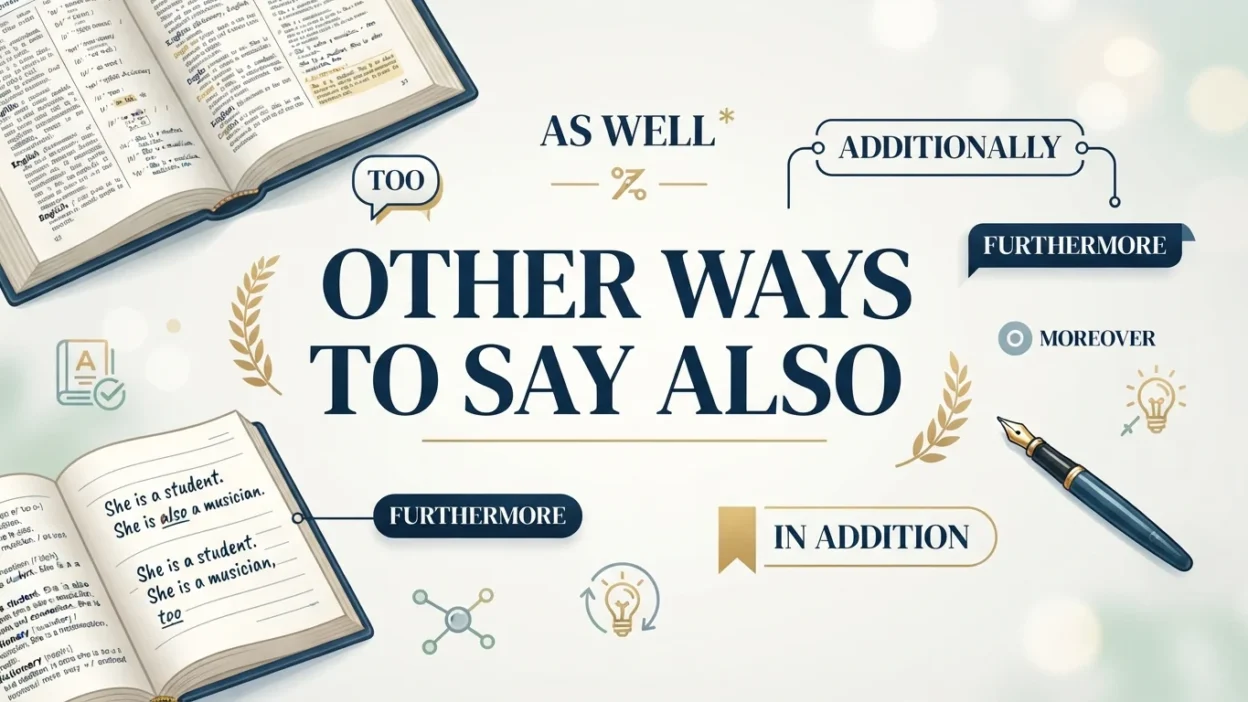
Finding other ways to say also can make your English sound more natural, varied, precise, and professional. Although also is one of the most common words used to add information, repeating it too often can make writing feel predictable. English offers many alternatives, including too, as well, additionally, furthermore, moreover, besides, and in addition.
The best alternative depends on your sentence position, level of formality, and relationship between ideas. Some expressions work naturally at the end of a sentence, while others are better at the beginning of a new sentence or paragraph.
Quick Answer:
Common alternatives include too, as well, additionally, furthermore, moreover, in addition, besides, and likewise. Choose the expression based on sentence position, tone, and whether you are speaking or writing.
What Are Other Ways to Say Also?
1. Too
Meaning: Too means “also” or “in addition.” It is one of the easiest and most natural alternatives.
Usage rule: It usually appears at the end of a sentence or clause.
Example: “I enjoyed the movie too.”
Tip: In everyday conversation, too often sounds more relaxed than also. Avoid placing it randomly in the middle of a sentence.
2. As Well
Meaning: As well also means “in addition” or “also.”
Usage rule: It commonly appears at the end of a sentence, especially in conversational English.
Example: “She speaks Spanish as well.”
Tip: As well is particularly useful when you want a natural alternative to repeatedly using also.
3. Additionally
Meaning: Additionally introduces another related fact or point.
Usage rule: It is more common in formal, academic, business, and professional writing.
Example: “Additionally, the report includes three case studies.”
Tip: Use it when adding a separate but relevant piece of information rather than simply replacing also word for word.
4. Furthermore
Meaning: Furthermore means “in addition” and often introduces information that strengthens or develops a previous point.
Usage rule: It normally appears at the beginning of a sentence and is followed by a comma.
Example: “The plan is affordable. Furthermore, it is easy to implement.”
Tip: It sounds formal, so it may feel too serious for casual conversation.
5. Moreover
Meaning: Moreover adds information, often emphasizing an additional important point.
Usage rule: It usually introduces a new sentence or independent clause.
Example: “The product is affordable. Moreover, it is durable.”
Tip: Moreover is especially useful in essays, reports, arguments, and formal explanations.
6. In Addition
Meaning: In addition means that another fact, item, or idea should be included.
Usage rule: It can introduce a new sentence or be followed by to plus a noun or gerund.
Example: “In addition, the company offers free delivery.”
Tip: Remember the related structure: “In addition to studying, she works part-time.”
7. Besides
Meaning: Besides can mean “in addition to” or “apart from.”
Usage rule: It can appear at the beginning or within a sentence, depending on meaning.
Example: “Besides English, he speaks Arabic.”
Tip: In some contexts, besides can introduce a supporting reason rather than merely another fact.
What Are the Most Natural Alternatives to Also?
1. Too in Everyday Conversation
Meaning: Too expresses an additional fact, feeling, action, or agreement.
Usage rule: Put it near the end of the sentence in most everyday situations.
Example: “I want to come too.”
Tip: This is one of the safest choices when speaking casually with friends, family, or coworkers.
2. As Well in Conversation
Meaning: As well has almost the same meaning as too.
Usage rule: It normally comes at the end of the sentence.
Example: “We invited David as well.”
Tip: Do not confuse as well with as well as. The latter introduces an additional person, thing, or activity.
3. In Addition in General Writing
Meaning: In addition introduces another piece of information.
Usage rule: It is especially useful when connecting two complete ideas.
Example: “The hotel has free Wi-Fi. In addition, breakfast is included.”
Tip: It works well when you want your writing to feel organized without sounding excessively formal.
4. Additionally in Professional Writing
Meaning: Additionally means “also” but often sounds more formal and structured.
Usage rule: Place it at the beginning of a sentence followed by a comma.
Example: “Additionally, employees receive annual training.”
Tip: Use it in reports, business documents, instructions, and professional emails.
5. Furthermore in Formal Arguments
Meaning: Furthermore adds another point that supports the preceding statement.
Usage rule: Use it mainly to connect ideas in formal writing.
Example: “The policy reduces costs. Furthermore, it improves efficiency.”
Tip: It is stronger and more formal than too or as well.
6. Moreover for Emphasis
Meaning: Moreover introduces an additional point that the writer considers significant.
Usage rule: It normally connects related sentences or clauses.
Example: “The course is inexpensive. Moreover, it is available online.”
Tip: Do not use moreover simply to make every sentence sound formal. Naturalness matters more than formality.
7. Also as the Neutral Choice
Meaning: Also directly means “in addition.”
Usage rule: It can appear before the main verb, after a form of be, or in other positions depending on sentence structure.
Example: “She also teaches mathematics.”
Tip: There is nothing wrong with using also. Alternatives are useful for variety, not because also is incorrect.
How Do You Use Also Alternatives in Different Sentence Positions?
1. Beginning of a Sentence
Meaning: A sentence-opening expression adds a new related idea.
Usage rule: Additionally, furthermore, moreover, and in addition commonly work here.
Example: “Additionally, students receive printed materials.”
Tip: A comma usually follows these introductory expressions.
2. Middle of a Sentence
Meaning: A middle-position expression adds information within the same grammatical structure.
Usage rule: Also commonly appears before the main verb.
Example: “Maria also works on weekends.”
Tip: With the verb be, also generally follows the verb: “Maria is also available.”
3. End of a Sentence
Meaning: An ending expression adds agreement, inclusion, or another shared fact.
Usage rule: Too and as well are particularly natural here.
Example: “I would like some coffee too.”
Tip: This position is especially common in informal speech.
4. After a Subject
Meaning: Also can add information directly after the subject.
Usage rule: This placement is common when emphasizing the additional action of the subject.
Example: “James also plays tennis.”
Tip: This is often more natural than moving also to an unusual position.
5. Before the Main Verb
Meaning: This placement clearly connects also with the action.
Usage rule: Place also before most main verbs.
Example: “They also visited the museum.”
Tip: This is one of the most common grammatical patterns for also.
6. After the Verb Be
Meaning: Also follows a form of be when it adds information about the subject.
Usage rule: Place it after am, is, are, was, or were.
Example: “The restaurant is also popular with tourists.”
Tip: Compare: “She also works here” but “She is also a teacher.”
7. Between Auxiliary and Main Verb
Meaning: Also can occur between an auxiliary verb and the main verb.
Usage rule: This is common with modal and auxiliary constructions.
Example: “You can also contact us by email.”
Tip: Keep the placement natural rather than moving also simply to avoid repetition.
Which Alternatives Are Best for Formal and Academic English?
1. Additionally
Meaning: Additionally adds another point in a clear, formal way.
Usage rule: Use it when introducing another supporting fact or consideration.
Example: “Additionally, the research examined long-term effects.”
Tip: It is a dependable choice for reports and academic assignments.
2. Furthermore
Meaning: Furthermore adds a point that strengthens an argument or explanation.
Usage rule: Use it when the new information develops the previous point.
Example: “The method is inexpensive. Furthermore, it requires little equipment.”
Tip: It works particularly well in analytical writing.
3. Moreover
Meaning: Moreover adds an important or persuasive supporting point.
Usage rule: It generally introduces an independent sentence or clause.
Example: “The approach is practical. Moreover, it has been tested in several settings.”
Tip: Use it selectively because excessive formal connectors can make writing sound stiff.
4. In Addition
Meaning: In addition signals that another fact should be considered.
Usage rule: It commonly begins a new sentence.
Example: “In addition, participants completed a written assessment.”
Tip: It is formal enough for academic writing but still easy to understand.
5. Likewise
Meaning: Likewise means “in the same way” or “similarly,” rather than simply “also.”
Usage rule: Use it when the second idea resembles or corresponds to the first.
Example: “The first experiment produced positive results. Likewise, the second experiment was successful.”
Tip: Do not use likewise when the second statement is merely additional and not similar.
6. Equally
Meaning: Equally can introduce another point that is similarly important.
Usage rule: It is useful when connecting two ideas with comparable importance.
Example: “The program improves access. Equally, it reduces unnecessary costs.”
Tip: Its meaning is more specific than also, so use it when equality or comparable importance is intended.
7. Not Only…But Also
Meaning: This paired structure emphasizes two connected facts or qualities.
Usage rule: Keep the grammatical structures after not only and but also parallel.
Example: “The course is not only affordable but also flexible.”
Tip: Parallel structure is essential: “She not only writes but also edits” is better than mixing unrelated grammatical forms.
How Do You Use Alternatives to Also in Professional Writing?
1. In Business Emails
Meaning: Professional alternatives help connect information clearly.
Usage rule: Use additionally or in addition when introducing another business detail.
Example: “Additionally, I have attached the revised schedule.”
Tip: Avoid filling every email with formal connectors. Simple language is often more professional.
2. In Reports
Meaning: Reports often need clear transitions between related findings.
Usage rule: Use furthermore, additionally, or in addition when appropriate.
Example: “The survey showed increased satisfaction. Furthermore, response times improved.”
Tip: Choose the connector according to the logical relationship between findings.
3. In Cover Letters
Meaning: Alternatives to also can help present qualifications without repetitive wording.
Usage rule: Use phrases such as in addition when adding another relevant qualification.
Example: “In addition, I have three years of customer-service experience.”
Tip: Focus on relevant information rather than adding connectors simply for variety.
4. In Presentations
Meaning: Spoken presentations need transitions that listeners can easily follow.
Usage rule: Also, in addition, and another point is can introduce additional information.
Example: “In addition, I would like to discuss the project’s timeline.”
Tip: Spoken English usually benefits from simpler connectors than highly formal academic prose.
5. In Customer Communication
Meaning: Alternatives can make customer-facing messages clearer and more polished.
Usage rule: Use also, additionally, or as well depending on formality.
Example: “We also offer weekend delivery.”
Tip: Prioritize clarity. A customer should understand the message immediately.
6. In Workplace Instructions
Meaning: Additional information can be introduced with clear linking expressions.
Usage rule: Use also for simple instructions and in addition for separate requirements.
Example: “Please complete the form. In addition, attach a copy of your identification.”
Tip: Avoid obscure vocabulary when the goal is to give instructions.
7. In Professional Recommendations
Meaning: A second recommendation can be connected to the first using an appropriate transition.
Usage rule: Additionally and in addition work well when presenting related suggestions.
Example: “Consider updating the website. Additionally, review the contact information.”
Tip: Keep each recommendation specific so the transition does not hide the main point.
What Are the Best Alternatives to Also in Everyday English?
1. Too for Casual Speech
Meaning: Too means “also” and often communicates inclusion.
Usage rule: Put it near the end of a sentence.
Example: “I love this song too.”
Tip: It is one of the most natural choices for everyday conversation.
2. As Well for Natural Conversation
Meaning: As well also indicates that something is true for another person or situation.
Usage rule: It usually appears at the end.
Example: “My brother wants to go as well.”
Tip: It is common in both British and American English.
3. Plus for Informal Addition
Meaning: Plus can mean “in addition” when adding another reason or fact.
Usage rule: It is common in informal speech and writing.
Example: “The apartment is cheap, plus it is close to work.”
Tip: Avoid plus in highly formal academic writing unless the context supports a conversational style.
4. And for Simple Addition
Meaning: And connects two related ideas without requiring a more specialized transition.
Usage rule: Use it when two items or actions are naturally connected.
Example: “She sings and plays the piano.”
Tip: Do not assume every sentence needs a sophisticated synonym for also. Simple and is often the clearest choice.
5. Another Point Is
Meaning: Another point is introduces an additional idea.
Usage rule: It is useful when speaking or organizing an explanation.
Example: “Another point is that the service is available 24 hours a day.”
Tip: This expression works well in presentations and discussions.
6. On Top of That
Meaning: On top of that means “in addition to what was already mentioned.”
Usage rule: It is informal and often adds emphasis.
Example: “The car is comfortable, and on top of that, it is fuel-efficient.”
Tip: It is natural in conversation but usually too informal for formal academic writing.
7. What Is More
Meaning: What is more introduces an additional point, often one that strengthens the previous statement.
Usage rule: It is more common in formal or literary writing than casual speech.
Example: “The building is historic. What is more, it remains in excellent condition.”
Tip: Use it sparingly because simpler alternatives are often more natural.
Placement & Grammar Rules Table
| Synonym/Phrase | Sentence Position/Placement | Tone/Formality | Example Sentence | Common Mistake |
| Also | Usually before main verb; after be | Neutral | She also teaches English. | Placing it randomly |
| Too | Usually at the end | Casual/neutral | I enjoyed it too. | Using it in every formal sentence |
| As well | Usually at the end | Neutral/casual | He came as well. | Confusing it with as well as |
| Additionally | Usually at the beginning | Formal | Additionally, costs were reduced. | Using it in casual speech too often |
| Furthermore | Usually at the beginning | Formal | Furthermore, the plan saves time. | Using it when no supporting connection exists |
| Moreover | Usually at the beginning | Formal | Moreover, the method is reliable. | Treating it as an exact replacement in every context |
| In addition | Usually at the beginning | Neutral/formal | In addition, training is provided. | Forgetting the comma in introductory use |
| Besides | Beginning or before a noun | Neutral | Besides English, she speaks French. | Confusing meanings |
| Likewise | Usually beginning or middle | Formal/neutral | Likewise, the second group improved. | Using it when ideas are not similar |
| Plus | Middle or beginning | Informal | Plus, it is inexpensive. | Using it in formal reports |
| On top of that | Usually beginning | Informal | On top of that, parking is free. | Using it in academic writing |
| Not only…but also | Paired structure | Neutral/formal | She is not only smart but also creative. | Breaking parallel structure |
Common Mistakes When Using Alternatives to Also
1. Using Too in the Wrong Position
Meaning: Too generally adds information or agreement.
Usage rule: It most naturally appears at the end of a sentence.
Example: “I want to go too.”
Tip: Although other positions are possible in special constructions, beginners should usually keep too near the end.
2. Confusing Also With As Well As
Meaning: Also adds information, while as well as connects additional nouns, phrases, or activities.
Usage rule: Use as well as when its grammatical structure fits the sentence.
Example: “She teaches English as well as mathematics.”
Tip: Do not replace also and as well as mechanically. Their sentence structures differ.
3. Overusing Formal Connectors
Meaning: Formal words such as moreover and furthermore add information but also affect tone.
Usage rule: Match the connector to the audience and situation.
Example: “Furthermore, the results support the theory.”
Tip: In a casual message, “The results also support the theory” may sound more natural.
4. Using Moreover Without a Logical Connection
Meaning: Moreover normally adds a supporting point.
Usage rule: The new statement should have a meaningful relationship with the previous idea.
Example: “The phone is affordable. Moreover, its battery lasts all day.”
Tip: If the second sentence has no logical connection, use a simpler transition or restructure the paragraph.
5. Treating Every Synonym as Identical
Meaning: Words that share a general meaning can have different grammatical or stylistic uses.
Usage rule: Choose based on placement, tone, and meaning.
Example: “I like it too” is natural, while “I like it furthermore” is incorrect.
Tip: Learn alternatives as sentence patterns rather than as isolated vocabulary items.
6. Forgetting Commas After Introductory Connectors
Meaning: Many sentence-opening transition words are followed by a comma.
Usage rule: Use a comma after expressions such as additionally, furthermore, and moreover when they introduce a sentence.
Example: “Additionally, the service is available online.”
Tip: Correct punctuation helps readers identify the transition clearly.
7. Changing Meaning While Avoiding Repetition
Meaning: Replacing also should not change the intended relationship between ideas.
Usage rule: Use a synonym only when its meaning fits the context.
Example: Use likewise when ideas are similar, not merely additional.
Tip: Accuracy is more important than avoiding repeated words.
Practical Paragraph Examples
1. A Casual Conversation
Meaning: Casual English generally favors short, familiar expressions.
Usage rule: Use too and as well naturally in conversation.
Example: “I am going to the market this afternoon. My sister is coming too, and my brother wants to come as well.”
Tip: Natural spoken English does not require formal transition words.
2. A Student Essay
Meaning: Academic writing benefits from clear connections between ideas.
Usage rule: Use in addition, furthermore, or moreover when they accurately express the relationship.
Example: “Regular reading improves vocabulary. In addition, it exposes students to different sentence structures and writing styles. Furthermore, reading can improve comprehension.”
Tip: Do not add a transition to every sentence. Use one when it improves the flow.
3. A Business Email
Meaning: Professional emails should be concise and easy to understand.
Usage rule: Additionally and in addition are useful for introducing separate information.
Example: “The revised proposal is attached. Additionally, I have included the updated pricing sheet for your review.”
Tip: Keep the main message visible instead of hiding it behind complicated vocabulary.
4. A Product Description
Meaning: Product descriptions often need to present several benefits.
Usage rule: Use also, as well as, or in addition according to the sentence structure.
Example: “The laptop has a lightweight design. It also offers a long-lasting battery and a comfortable keyboard.”
Tip: Simple wording often communicates product benefits more effectively.
5. A Formal Report
Meaning: Reports use transitions to connect evidence and conclusions.
Usage rule: Furthermore and additionally can introduce supporting information.
Example: “The survey identified a significant increase in customer satisfaction. Additionally, the number of repeat purchases increased during the same period.”
Tip: Make sure each added fact is relevant to the report’s central purpose.
6. A Presentation
Meaning: Presentations require transitions that listeners can follow quickly.
Usage rule: Use simple expressions such as also, in addition, and another point is.
Example: “Another point is the project’s cost. In addition, we need to consider how long implementation will take.”
Tip: Spoken language usually sounds better when transitions are clear rather than overly formal.
7. Creative Writing
Meaning: Creative writing can use varied expressions to control rhythm and emphasis.
Usage rule: Choose transitions according to the narrator’s voice and the desired effect.
Example: “The road was empty. Moreover, the silence seemed to stretch for miles.”
Tip: In creative writing, repetition can sometimes be intentional, so do not replace every occurrence of also automatically.
Frequently Asked Questions
1. What is another word for also?
Meaning: Common alternatives include too, as well, additionally, furthermore, moreover, and in addition.
Usage rule: Choose according to tone and sentence position.
Example: “She also sings” can become “She sings too.”
Tip: Too is usually the easiest everyday alternative.
2. What is a formal way to say also?
Meaning: Formal alternatives include additionally, furthermore, moreover, and in addition.
Usage rule: Use them when the context requires a formal or structured tone.
Example: “Additionally, the study examined long-term outcomes.”
Tip: Do not choose a formal word simply because it sounds sophisticated.
3. Can I use too instead of also?
Meaning: In many sentences, too and also communicate the same basic idea.
Usage rule: Too commonly appears at the end, while also often appears before the main verb.
Example: “She also likes tea” and “She likes tea too.”
Tip: The sentence structure usually changes when you switch between them.
4. Is as well the same as also?
Meaning: Yes, as well commonly means “also.”
Usage rule: It usually appears at the end of a sentence.
Example: “He wants to participate as well.”
Tip: Remember that as well as is a different grammatical construction.
5. Is moreover the same as also?
Meaning: Moreover can add information, but it usually has a stronger formal and argumentative function.
Usage rule: It often introduces an additional supporting point.
Example: “The plan is practical. Moreover, it is affordable.”
Tip: Use moreover when the relationship between ideas justifies its formal tone.
6. Can I start a sentence with also?
Meaning: Yes, beginning a sentence with also is grammatically possible.
Usage rule: It can be used as a sentence connector, although also often sounds smoother in the middle of a sentence.
Example: “Also, remember to bring your identification.”
Tip: In formal writing, additionally or in addition may sometimes provide a smoother transition.
7. How can I avoid repeating also?
Meaning: You can vary your vocabulary while preserving the intended meaning.
Usage rule: Consider too, as well, additionally, in addition, furthermore, or moreover where appropriate.
Example: “The course is affordable. In addition, it is available online.”
Tip: Do not replace every also. Repetition is acceptable when the repeated word is the clearest choice.
Final Thoughts
There are many natural ways to replace also, but the best choice depends on meaning, sentence position, and tone.
Use too and as well for everyday English, while additionally and in addition suit professional writing.
Furthermore and moreover are useful when adding formal supporting points.
Good English is not about avoiding a word at all costs. Choose the expression that communicates your idea clearly, naturally, and accurately.
Learning these patterns will give your writing more flexibility without making it unnecessarily complicated.