
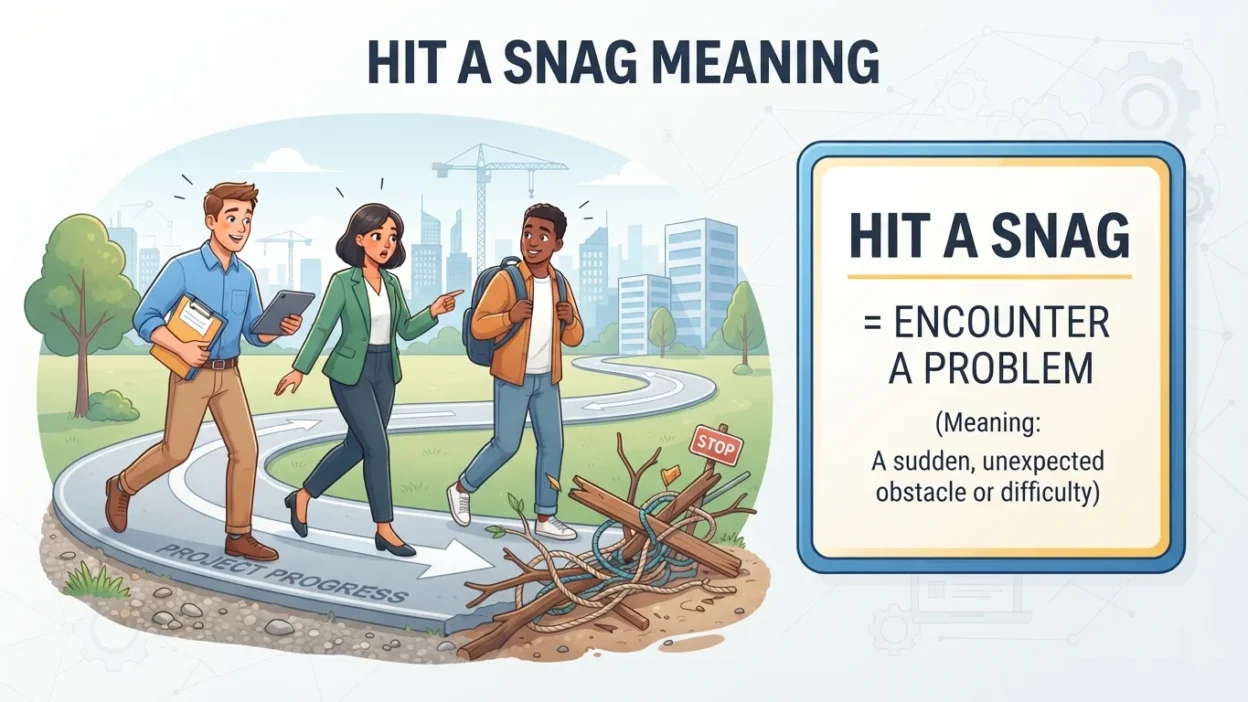
The phrase “hit a snag” is a common English idiom meaning to encounter an unexpected problem, difficulty, or delay while trying to do something. It is usually used when a plan or process was going well but suddenly faced an obstacle.
For example, if someone says, “We hit a snag while planning the event,” they mean that an unexpected problem came up during the planning process. The problem does not necessarily mean the entire plan has failed—it may simply need to be solved before things can continue. “Hit a snag” is common in both everyday conversation and professional English. In this guide, you’ll learn its exact meaning, grammar, examples, synonyms, common mistakes, and the difference between a snag and more serious problems.
Quick Answer
“Hit a snag” means to encounter an unexpected problem, obstacle, or delay. It is usually used when something was progressing normally but a difficulty suddenly interrupted the process.
Why People Confuse It
The phrase can be confusing because snag has several meanings as a noun and verb.
As an idiom:
Hit a snag = encounter a problem.
But in other contexts, a snag can mean a small tear, a sharp projection, or something that catches onto another object.
For example:
“My sweater got a snag.”
This is different from:
“We hit a snag with the project.”
The second sentence is about a problem or obstacle.
First Word: Hit
In “hit a snag,” the word hit does not literally mean physically striking something.
Instead, it means to suddenly encounter or come across something.
Compare:
“We hit a problem.”
This means:
“We encountered a problem.”
So hit is being used figuratively.
Second Word: Snag
A snag can mean a minor or unexpected problem that interrupts progress.
When combined with hit, it creates the idiom:
hit a snag
The problem may cause:
- A delay
- An interruption
- Extra work
- A change of plans
- Temporary difficulty
Usually, the expression suggests that the problem is manageable, rather than completely disastrous.
Comparison Table
| Expression | Meaning | Example |
|---|---|---|
| Hit a snag | Encounter an unexpected problem | We hit a snag with the project. |
| Run into a problem | Encounter a difficulty | We ran into a problem. |
| Face an obstacle | Encounter something preventing progress | They faced an obstacle. |
| Setback | A problem that delays progress | The team suffered a setback. |
| Complication | Something that makes a situation more difficult | A complication delayed the plan. |
| Dead end | A situation where no progress is possible | The investigation reached a dead end. |
When to Use “Hit a Snag”
Use “hit a snag” when something was progressing but an unexpected difficulty appeared.
It works especially well with:
- Plans
- Projects
- Travel
- Work
- Construction
- Applications
- Negotiations
- Technology
- Events
Examples
“We hit a snag while organizing the trip.”
“The project hit a snag because the equipment arrived late.”
“I hit a snag while trying to complete the application.”
The idiom can be used in both casual and professional conversations.
Examples of “Hit a Snag”
- We hit a snag while planning the wedding.
- The project hit a snag because of a technical problem.
- I hit a snag while trying to install the software.
- The construction work hit a snag after the materials were delayed.
- We hit a snag with our travel arrangements.
- The team hit a snag during the final stage of development.
- I was almost finished when I hit a snag.
- The negotiations hit a snag over the price.
- Our plans hit a snag when the venue became unavailable.
- The application process hit a snag because one document was missing.
- We hit a snag, but we managed to solve the problem.
- The event preparations hit a few snags along the way.
Common Mistakes
Mistake 1: Thinking it means complete failure
Hit a snag usually means encountering a problem, not necessarily failing completely.
“We hit a snag, but the project is still on schedule.”
The problem was temporary or manageable.
Mistake 2: Using the wrong preposition
The most common structure is:
hit a snag
You can also say:
hit a snag with something
For example:
“We hit a snag with the payment.”
Mistake 3: Taking “hit” literally
In this idiom, hit is figurative.
“We hit a snag.”
does not mean that someone physically hit something.
Mistake 4: Confusing it with “snag” as a physical problem
A snag can also describe something that catches or tears material.
“There’s a snag in my sweater.”
That meaning is different from the idiom “hit a snag.”
Memory Trick
Think of a project as a road.
You are moving forward normally, and suddenly there is a snag blocking your progress.
So:
Hit a snag = suddenly encounter a problem.
An easy synonym is:
Hit a snag = run into a problem.
American vs British English
“Hit a snag” is used in both American and British English.
The meaning is essentially the same:
encounter an unexpected problem or obstacle.
It is natural in everyday speech and also acceptable in professional communication.
For example:
“We hit a snag with the schedule.”
works naturally in both varieties of English.
Similar Words
Run Into a Problem
“We ran into a problem during testing.”
This is one of the closest alternatives.
Face an Obstacle
“The team faced an obstacle during development.”
This sounds slightly more formal.
Encounter a Difficulty
“The researchers encountered a difficulty.”
This is appropriate for formal or academic writing.
Experience a Setback
“The project experienced a setback.”
A setback often suggests that progress has been pushed backward.
Have a Problem
“We had a problem with the equipment.”
This is simpler and more direct.
Final Verdict
“Hit a snag” means to encounter an unexpected problem, obstacle, or delay while trying to accomplish something. It is a useful English idiom because it usually suggests that progress has been interrupted rather than completely stopped.
If someone says, “We hit a snag,” they are essentially saying, “We ran into a problem.” The expression works naturally in both casual and professional English and is especially common when discussing projects, plans, work, travel, or arrangements.
FAQs
1. What does “hit a snag” mean?
It means to encounter an unexpected problem, difficulty, or delay.
2. Is “hit a snag” an idiom?
Yes. It is a common English idiom meaning to run into a problem or obstacle.
3. Is “hit a snag” formal or informal?
It is neutral and conversational. It can be used in everyday speech and many professional situations.
4. What is a synonym for “hit a snag”?
Common alternatives include:
- Run into a problem
- Encounter a difficulty
- Face an obstacle
- Experience a setback
- Run into trouble
5. Does “hit a snag” mean failure?
Not necessarily. It usually means that something has encountered a temporary or manageable problem.
6. Can I say “hit a snag with”?
Yes.
“We hit a snag with the schedule.”
This means you encountered a problem concerning the schedule.
7. What is an easy example of “hit a snag”?
“We were ready to leave, but we hit a snag when the car wouldn’t start.”
The car problem delayed the plan.
Conclusion
The idiom “hit a snag” is a simple way to describe an unexpected problem that interrupts progress. It can be used for anything from a small issue with a daily plan to a complication in a large project. The phrase usually suggests that the obstacle can potentially be overcome.
Remember that “hit” is not literal here, and “snag” represents the problem or obstacle. If you can replace the phrase with “ran into a problem,” you have probably understood it correctly.
Remember This
Hit a snag = encounter an unexpected problem or obstacle.

Baylor Wylder is a culture and lifestyle blogger with a modern frontier perspective.
He writes about creativity, independence, and building a life with purpose.
His work blends reflection, ambition, and contemporary style.