
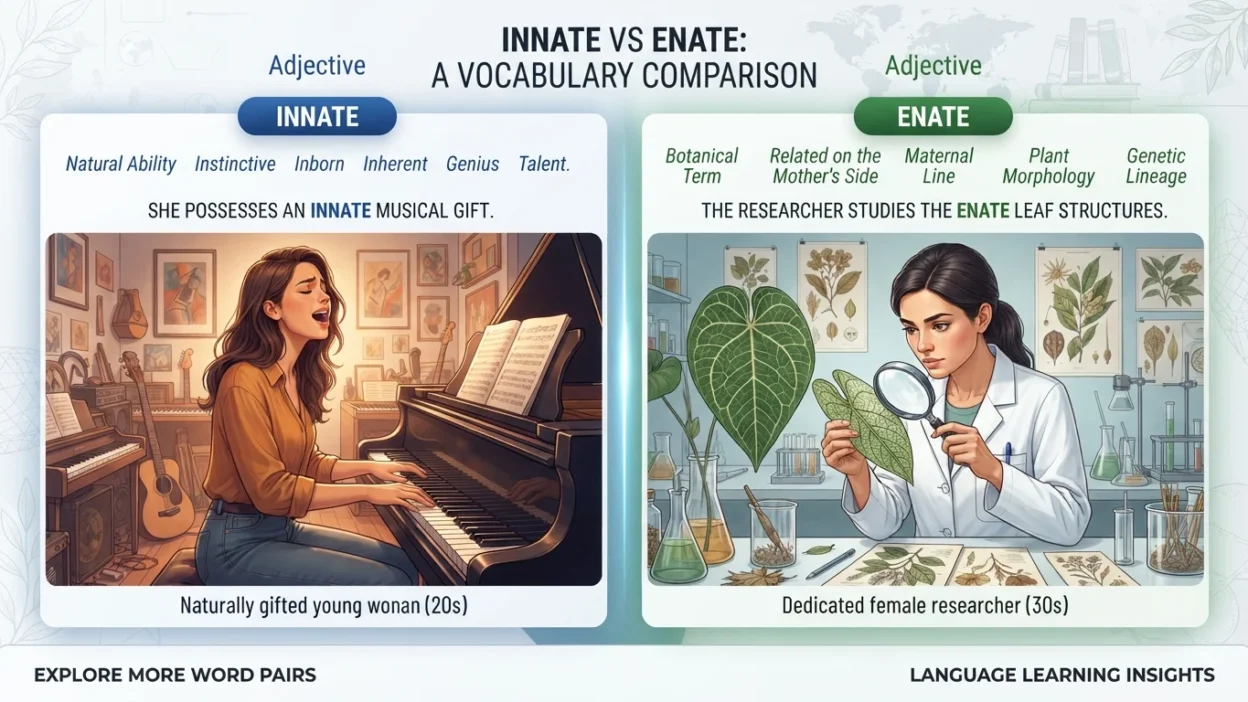
The words “innate” and “enate” look and sound similar, so it is easy to wonder whether they have the same meaning. However, they are completely different words. Innate is a common English adjective used to describe something that is natural, inborn, or present from birth. Enate, on the other hand, is a rare technical word, mainly used in biology and botany, and is not normally used in everyday English.
If you are writing an essay, preparing for an English test, or simply trying to improve your vocabulary, knowing the difference between these two words can prevent an easy spelling mistake. This guide explains innate vs enate with clear definitions, examples, usage rules, common mistakes, synonyms, pronunciation tips, and a simple memory trick. You will also learn when innate is the right word and why enate should generally be avoided unless you are discussing a specialized scientific topic.
Quick Answer
Innate means natural, inborn, or present from birth. Enate is a rare technical term related to biological relationships, particularly in botany. For everyday English, innate is almost certainly the word you need.
Why People Confuse It
The confusion comes mainly from spelling and pronunciation.
Compare:
- Innate → natural or inborn
- Enate → a rare technical/scientific term
Both contain the same basic sounds, and only the first vowel changes.
However, their meanings have nothing to do with each other in ordinary usage.
If you want to describe a natural ability, quality, characteristic, or tendency, use innate.
“She has an innate ability to understand languages.”
First Word: Innate
Innate is a common adjective meaning natural, inborn, or existing from birth.
Something innate is not necessarily something you learned through education or practice. It is a characteristic or ability that is naturally present.
Examples
- innate talent
- innate ability
- innate intelligence
- innate instinct
- innate quality
- innate tendency
For example:
“She has an innate talent for music.”
This means her musical ability seems naturally present rather than entirely developed through training.
Another example:
“Humans have an innate ability to learn language.”
Here, innate means naturally present.
Second Word: Enate
Enate is a rare technical word. It is mainly encountered in specialized biological or botanical terminology rather than normal everyday English.
In botanical terminology, enate can describe structures or relationships in which something is joined to or growing from the side of another structure.
The word is uncommon enough that most English learners will rarely need it.
Example
“The botanical structure was described as enate.”
This is a specialized scientific use, not something you would normally use in conversation.
Important point
Do not use enate when you mean:
- Natural
- Inborn
- Instinctive
- Inherent
For those meanings, the correct word is innate.
Comparison Table
| Feature | Innate | Enate |
|---|---|---|
| Word type | Adjective | Rare technical adjective |
| Main meaning | Natural or inborn | Relating to a specialized biological/botanical structure |
| Common in everyday English? | Yes | No |
| Common context | Psychology, education, general English | Botany and specialized biology |
| Example | She has an innate ability. | The structure was described as enate. |
| Common synonyms | Inborn, natural, inherent | Technical botanical terminology |
When to Use Each
Use “Innate” for Natural Qualities
Use innate when something is naturally present rather than acquired.
“He has an innate sense of rhythm.”
“Children have an innate curiosity.”
“She showed an innate ability to solve problems.”
Use “Enate” Only in Specialized Contexts
Enate should generally be used only when you are dealing with its specific technical meaning.
If you are writing ordinary English, innate is almost certainly what you want.
Quick test
Ask:
“Do I mean natural or inborn?”
If yes → innate.
If you are describing a specialized biological or botanical structure → enate may be appropriate.
Examples of Innate vs Enate
Innate
- “She has an innate ability to communicate with people.”
- “Curiosity is an innate human trait.”
- “He demonstrated an innate talent for drawing.”
- “Some animals have an innate instinct for survival.”
- “The child showed an innate interest in music.”
- “Leadership may involve both learned and innate qualities.”
- “Humans have an innate capacity for learning.”
- “Her innate creativity was obvious from an early age.”
Enate
- “The botanist used the term enate to describe the plant structure.”
- “The structures were examined for their enate arrangement.”
- “The researcher described the feature using specialized enate terminology.”
The last examples are intentionally technical because enate is rarely used outside specialized scientific contexts.
Common Mistakes
Mistake 1: Writing “enate” when you mean “innate”
❌ “She has an enate talent for music.”
✅ “She has an innate talent for music.”
Talent can be naturally present, so innate is correct.
Mistake 2: Assuming “innate” means “learned”
Innate means the opposite of something being entirely acquired through experience or training.
Compare:
Innate ability = naturally present ability
Learned ability = ability developed through experience or training
Mistake 3: Using “enate” in ordinary conversation
Because enate is rare and specialized, using it when you mean “natural” will make your sentence incorrect.
Instead of:
“He has an enate understanding of mathematics.”
say:
“He has an innate understanding of mathematics.”
Memory Trick
Here is an easy way to remember it:
INNATE = IN YOU
Think:
INNATE = naturally IN you.
So:
Innate talent → talent naturally in you.
Innate ability → ability naturally present.
Innate instinct → instinct naturally present.
For enate, remember that it is a specialized scientific word, not the everyday alternative to innate.
American vs British English
There is no significant difference between American and British English in the meaning of innate.
Both varieties commonly use:
“an innate ability”
“an innate characteristic”
“an innate instinct”
Enate is also not an American-versus-British spelling difference. It is simply a rare technical word.
So you should not choose enate because you are writing British English or innate because you are writing American English.
Similar Words
Inborn
Means present from birth.
“She has an inborn talent for music.”
Inherent
Means naturally existing as a permanent or essential part of something.
“Risk is inherent in the activity.”
Natural
Means existing naturally or not artificially produced.
“He has a natural ability to lead.”
Instinctive
Describes something done naturally without conscious reasoning.
“Her reaction was instinctive.”
Acquired
Means developed or obtained through experience, learning, or training.
“The skill was acquired through years of practice.”
Final Verdict
The difference between innate vs enate is straightforward: innate is the common English word meaning natural, inborn, or present from birth, while enate is a rare technical term primarily associated with specialized biological or botanical terminology.
If you are writing about someone’s natural talent, instinct, ability, quality, or tendency, choose innate. In almost every everyday English situation, innate is the word you need. Reserve enate for contexts where its specific scientific meaning is relevant.
FAQs
1. What is the difference between innate and enate?
Innate means natural or inborn. Enate is a rare technical term used mainly in specialized biological or botanical contexts.
2. Is “enate talent” correct?
No, not if you mean natural talent. The correct phrase is “innate talent.”
3. What does innate mean in simple English?
Innate means something that is naturally present or inborn, rather than learned.
4. Is innate the opposite of learned?
Generally, yes. Innate describes something naturally present, while a learned or acquired quality develops through experience, education, or training.
5. Is enate a common English word?
No. Enate is rare and mainly appears in specialized scientific or botanical writing.
6. What are synonyms for innate?
Common synonyms include inborn, natural, inherent, instinctive, and built-in, depending on the context.
7. Which word should I use in an English essay: innate or enate?
If you mean natural or inborn, use innate. Enate should only be used if its specialized scientific meaning is specifically relevant.
Conclusion
The easiest way to distinguish innate from enate is to focus on context. Innate is an everyday English adjective meaning something is naturally present, inborn, or inherent. It is commonly used with words such as talent, ability, instinct, quality, and curiosity.
Enate is a much rarer technical term and should not be treated as a synonym for innate. If your sentence is about a natural ability or characteristic, innate is the correct choice. Remembering “innate = naturally in you” is a simple way to avoid this spelling and vocabulary mistake.
Remember This
INNATE = natural, inborn, naturally IN you.
ENATE = rare technical/scientific term.
She has an innate talent for art. ✅
She has an enate talent for art. ❌

Miller Rhodes is an American nonfiction writer focused on personal growth and modern entrepreneurship.
His work blends thoughtful analysis with practical strategies for navigating today’s digital world.
He writes to help readers think clearer, act smarter, and build meaningful success.