“Is” and “are” are two forms of the verb “to be,” and choosing between them depends mainly on whether the subject is singular or plural. Because both words can appear in questions, statements, descriptions, and different verb tenses, learners often find this topic confusing.
The basic rule is simple: use “is” with a singular subject and “are” with a plural subject. For example, “The book is interesting” is correct because book is singular, while “The books are interesting” is correct because books is plural. However, some sentences can be trickier, especially when words come between the subject and the verb, when using “you,” or when dealing with collective nouns and phrases such as “there is” and “there are.” This guide explains is vs are with clear rules, examples, common mistakes, and practical tips.
Quick Answer
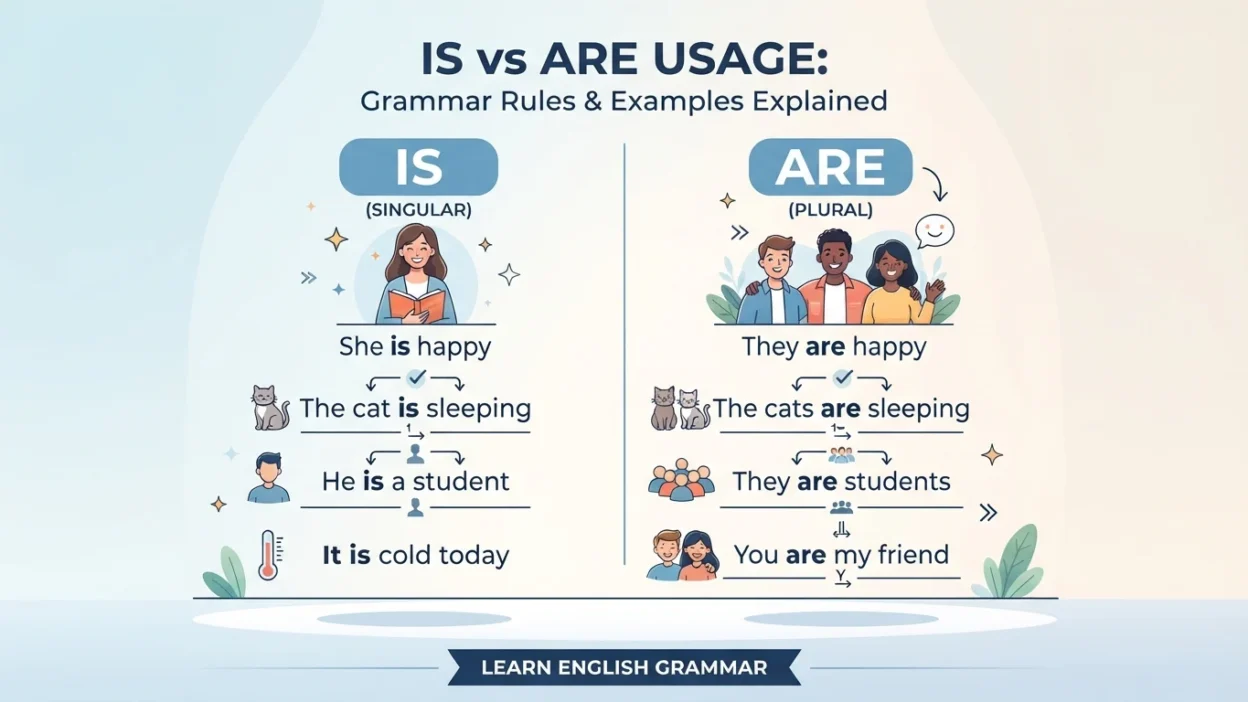
Use “is” with singular subjects and “are” with plural subjects. Use “is” with he, she, and it, while “are” is used with you, we, and they. Example: “She is happy,” but “They are happy.”
Why People Confuse It
The main reason learners confuse is and are is that English subjects don’t always appear immediately before the verb.
Compare:
The book is on the table.
The books are on the table.
That’s easy.
But consider:
The box of chocolates is on the table.
The subject is box, not chocolates, so we use is.
The key is to identify the real subject before choosing the verb.
First Word: Is
Is is the present-tense form of be used mainly with singular third-person subjects.
Use is with:
- He
- She
- It
- One person
- One thing
- One idea
Examples
He is tired.
She is a doctor.
It is cold.
The car is new.
My brother is at home.
The information is useful.
Second Word: Are
Are is the present-tense form of be used mainly with plural subjects and with you.
Use are with:
- You
- We
- They
- Two or more people
- Two or more things
Examples
You are kind.
We are ready.
They are students.
The cars are new.
My friends are here.
These books are interesting.
Comparison Table
| Subject | Correct Verb | Example |
|---|---|---|
| I | am | I am tired. |
| He | is | He is happy. |
| She | is | She is busy. |
| It | is | It is cold. |
| Singular noun | is | The cat is asleep. |
| You | are | You are late. |
| We | are | We are ready. |
| They | are | They are happy. |
| Plural noun | are | The cats are asleep. |
When to Use Each
Use “Is” With One Person or Thing
“The girl is happy.”
“My phone is broken.”
“The weather is beautiful.”
The subject is singular in each sentence.
Use “Are” With Two or More People or Things
“The girls are happy.”
“My phones are broken.”
“The flowers are beautiful.”
The subjects are plural.
“You” Always Takes “Are”
This is an important rule.
Whether you refers to one person or several people, use are.
“You are my best friend.”
“You are all invited.”
Never:
❌ “You is…”
Always:
✅ “You are…”
Examples of Is vs Are
- She is my sister.
- They are my classmates.
- The dog is sleeping.
- The dogs are sleeping.
- My phone is on the table.
- My shoes are under the bed.
- He is very friendly.
- We are ready to leave.
- The movie is interesting.
- The movies are interesting.
- This book is expensive.
- These books are expensive.
- The box of chocolates is heavy.
- The boxes of chocolates are heavy.
- Your friends are waiting outside.
Common Mistakes
Mistake 1: “You is”
❌ You is very kind.
✅ You are very kind.
Remember:
You + are
Mistake 2: Looking at the closest noun
Consider:
“The list of names is ready.”
The closest noun to is is names, but the main subject is list, which is singular.
So:
✅ “The list is ready.”
Mistake 3: “People is”
People is plural.
❌ “People is happy.”
✅ “People are happy.”
Mistake 4: “Everyone are”
Words such as everyone, everybody, someone, somebody, nobody, and each are grammatically singular.
So:
❌ “Everyone are ready.”
✅ “Everyone is ready.”
Mistake 5: Confusing “there is” and “there are”
Use:
There is + singular noun
There are + plural noun
Examples:
“There is a book on the table.”
“There are three books on the table.”
Memory Trick
Use this simple pattern:
Singular
He → is
She → is
It → is
Think:
He, She, It = IS
Plural
We → are
They → are
And remember:
You = ARE
A quick formula:
One → IS
More than one → ARE
But always remember that you takes are, even when talking to one person.
American vs British English
The basic rules for is and are are the same in American and British English.
One small difference can appear with collective nouns.
American English often treats a collective noun as singular:
“The team is winning.”
British English can sometimes treat collective nouns as plural when emphasizing the individual members:
“The team are playing well.”
However, this depends on context and style. For English learners, using a singular verb with a collective noun is generally a safe choice unless the context clearly requires otherwise.
Similar Words
Am
Use am with I.
“I am happy.”
Was
Past form used with I, he, she, and it.
“She was tired.”
Were
Past form used with you, we, and they.
“They were tired.”
Be
The base form.
“I want to be successful.”
Been
Past participle.
“She has been busy.”
Being
Present participle.
“He is being careful.”
Final Verdict
The basic difference between is and are is subject-verb agreement. Use is with singular subjects such as he, she, it, and singular nouns. Use are with plural subjects such as we, they, and plural nouns. Most importantly, you always takes are.
When a sentence seems confusing, don’t simply look at the noun closest to the verb. Find the main subject first. Once you identify whether that subject is singular or plural, choosing between is and are becomes much easier.
FAQs
1. When do I use “is”?
Use is with singular subjects.
“She is happy.”
“The car is new.”
2. When do I use “are”?
Use are with plural subjects and with you.
“They are happy.”
“You are right.”
3. Is “you is” ever correct?
In standard English, no.
✅ You are
❌ You is
4. Is “everyone is” or “everyone are” correct?
Everyone is is correct because everyone is grammatically singular.
“Everyone is ready.”
5. Is “people is” correct?
No. People is plural.
“People are waiting.”
6. What is the difference between “there is” and “there are”?
Use there is with one thing:
“There is a problem.”
Use there are with multiple things:
“There are several problems.”
7. What are the forms of “be” in the present tense?
The main present forms are:
- I am
- He/She/It is
- You/We/They are
Conclusion
Understanding is vs are starts with one basic idea: match the verb to the subject. A singular subject normally takes is, while a plural subject takes are. The special form you are is important because you always takes are, whether it refers to one person or several people.
The biggest challenge is often identifying the true subject of a sentence. Words such as of, with, and together with can appear between the subject and the verb and make the sentence look more complicated. Focus on the main subject, and the correct choice usually becomes clear.
Remember This
One → IS
More than one → ARE
You → ARE
The girl is happy. ✅
The girls are happy. ✅
You are happy. ✅

Watson Maddox is a leadership and mindset writer known for his bold, straightforward voice.
He shares lessons on resilience, discipline, and high performance drawn from real-world experience.
His mission is simple: build strength, take action, and never settle for average.