
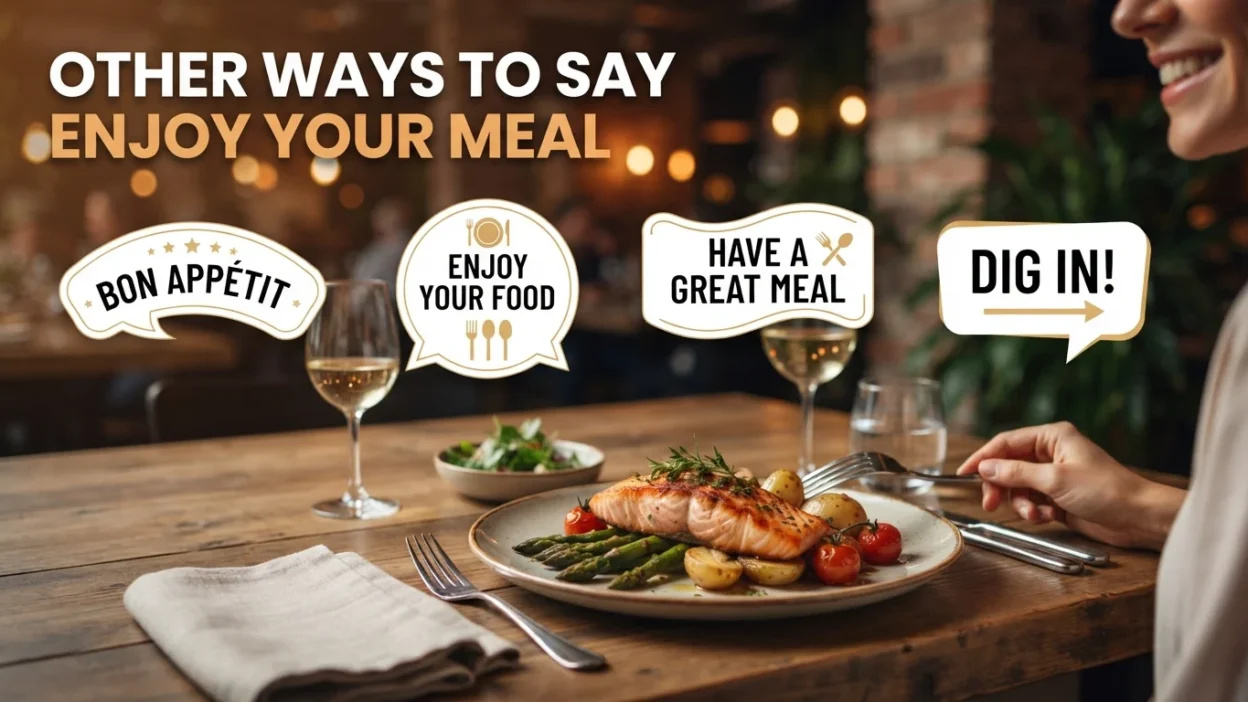
When someone is about to eat, saying “enjoy your meal” is a friendly way to wish them a pleasant dining experience. However, English offers many other expressions that can sound warmer, more casual, more elegant, or more natural depending on the situation. Knowing these alternatives can help you communicate confidently in restaurants, homes, workplaces, parties, and social gatherings.
Quick Answer:
Some natural alternatives include “bon appétit,” “enjoy,” “dig in,” “hope you enjoy your meal,” “have a great meal,” and “enjoy your food.” The best choice depends on your relationship with the listener, the setting, and the level of formality.
The phrase you choose can also communicate more than a simple good wish. “Dig in” sounds relaxed and enthusiastic, while “bon appétit” has a traditional dining feel. “I hope you enjoy your meal” sounds polite and thoughtful, making it suitable for professional or customer-service situations.
Natural Alternatives to Enjoy Your Meal
1. Bon Appétit
“Bon appétit” is one of the most widely recognized alternatives to “enjoy your meal.” It comes from French and literally relates to having a good appetite. In English, it is commonly used before someone starts eating.
Example: “Everything is ready. Bon appétit!”
Use it when you want a polished or traditional dining expression. It works especially well at dinner parties, restaurants, celebrations, and formal meals.
Tip: Although French in origin, “bon appétit” is commonly understood in English-speaking contexts.
2. Enjoy Your Food
“Enjoy your food” is a direct and natural alternative. It has almost the same meaning as “enjoy your meal,” but focuses specifically on the food.
Example: “Here’s your lunch. Enjoy your food!”
This phrase is appropriate in casual conversations and customer-service situations. It sounds friendly without being overly formal.
Tip: Use “enjoy your food” when referring specifically to what someone is eating rather than the entire dining experience.
3. Enjoy
“Enjoy” is one of the shortest alternatives. The context usually makes it clear that you mean “enjoy your meal.”
Example: “Your order is ready. Enjoy!”
It is especially common in restaurants, cafés, hotels, and other service settings. Friends and family can also use it naturally.
Tip: “Enjoy” is useful when you want to sound concise and friendly. The surrounding situation supplies the missing object.
4. Have a Great Meal
“Have a great meal” expresses a warm wish for someone’s dining experience. It is slightly more conversational than “enjoy your meal.”
Example: “The food looks delicious. Have a great meal!”
It works well with friends, colleagues, guests, and customers. It can also be used when leaving someone while they are about to eat.
Tip: “Have a great meal” is particularly useful when you want your expression to sound warm rather than traditional.
5. Hope You Enjoy Your Meal
“I hope you enjoy your meal” adds a personal and considerate tone. Instead of simply telling someone to enjoy the food, you express a positive wish.
Example: “Here is everything you ordered. I hope you enjoy your meal.”
This phrase is excellent for restaurant staff, hosts, servers, and anyone welcoming guests.
Tip: It sounds more complete and thoughtful than the shorter “enjoy your meal.”
6. Enjoy Your Dinner
“Enjoy your dinner” is a specific version of the standard expression. It is suitable when the meal is dinner.
Example: “The table is ready. Enjoy your dinner!”
You can similarly say “enjoy your breakfast” or “enjoy your lunch” when the time of day is known.
Tip: Match the phrase to the meal when you want to sound specific and natural.
7. Have a Good Meal
“Have a good meal” is simple, clear, and easy for English learners to use. It expresses the same general good wish.
Example: “You must be hungry. Have a good meal.”
It is suitable in casual and neutral situations. It may sound slightly less polished than “enjoy your meal,” but it is grammatically correct.
Tip: Choose this phrase when simplicity is more important than elegance.
Casual Ways to Wish Someone a Good Meal
1. Dig In
“Dig in” is an informal expression meaning “start eating.” It often shows enthusiasm and tells people that they do not need to wait.
Example: “The pizza is ready, so dig in!”
It is common among friends, family, and informal groups.
Tip: Avoid “dig in” in highly formal situations because it has a relaxed, conversational tone.
2. Tuck In
“Tuck in” is a friendly expression, particularly associated with British English. It means to begin eating enthusiastically.
Example: “Dinner is served, everyone. Tuck in!”
It works well at family meals and informal gatherings.
Tip: American English speakers may understand it, but “dig in” is generally more familiar in American casual speech.
3. Go Ahead and Eat
“Go ahead and eat” tells someone that they have permission or encouragement to begin.
Example: “Don’t wait for me. Go ahead and eat.”
It is especially useful when people are waiting for someone else before starting.
Tip: This expression can sound more like permission than a traditional meal greeting, so use it according to context.
4. Help Yourself
“Help yourself” means that someone should feel free to take food or serve themselves.
Example: “There’s plenty of food on the table. Help yourself.”
It is particularly useful at buffets, family gatherings, and informal dinners.
Tip: It does not always mean “enjoy your meal”; its main purpose is to encourage someone to take food freely.
5. Dig Right In
“Dig right in” is a more enthusiastic version of “dig in.” It strongly encourages immediate eating.
Example: “The burgers are still hot, so dig right in!”
It is appropriate for casual parties, picnics, family meals, and gatherings.
Tip: The word “right” adds enthusiasm and immediacy.
6. Enjoy!
“Enjoy!” is extremely common in casual speech. The listener understands the intended meaning from the context.
Example: “Here’s your coffee and sandwich. Enjoy!”
It is particularly natural in restaurants and cafés.
Tip: Because it is short, tone of voice matters. A warm delivery makes it sound friendly rather than abrupt.
7. Eat Up
“Eat up” encourages someone to eat, often because the food is ready or because the speaker wants them to have enough.
Example: “There’s plenty of food, so eat up!”
It is common with children and within families but can also be used playfully among adults.
Tip: With strangers or customers, “enjoy” is usually more polite and neutral.
Formal and Polite Alternatives
1. I Hope You Enjoy Your Meal
This expression is polite, complete, and professional. It communicates a genuine wish that the person has a pleasant dining experience.
Example: “Your table is prepared. I hope you enjoy your meal.”
It is suitable for restaurants, hotels, formal events, and hospitality settings.
Tip: This is one of the safest choices when you are unsure about the appropriate level of formality.
2. Please Enjoy Your Meal
“Please enjoy your meal” combines a polite marker with the standard dining wish.
Example: “Your dinner has been served. Please enjoy your meal.”
It works particularly well in hospitality and formal hosting.
Tip: “Please” is optional. Without it, the phrase can sound slightly more natural in everyday conversation.
3. I Hope You Have a Pleasant Meal
This is a more formal alternative to “enjoy your meal.” “Pleasant” emphasizes comfort and satisfaction.
Example: “Thank you for joining us. I hope you have a pleasant meal.”
It is appropriate for formal dinners, hospitality, and written messages.
Tip: Because “pleasant” is somewhat formal, it may sound unnatural among close friends.
4. Wishing You a Wonderful Meal
“Wishing you a wonderful meal” sounds warm and polished. It is particularly useful in written communication.
Example: “Thank you for visiting our restaurant. Wishing you a wonderful meal.”
It can appear on menus, greeting cards, hospitality messages, or event materials.
Tip: This expression feels more ceremonial than everyday conversation.
5. Please Enjoy the Food
“Please enjoy the food” politely directs attention toward the meal itself.
Example: “Everything has been prepared for you. Please enjoy the food.”
It is suitable for hosts, restaurants, parties, and professional events.
Tip: Use this phrase when the food is the main focus rather than the overall dining experience.
6. I Trust You Will Enjoy Your Meal
“I trust you will enjoy your meal” is highly formal. It expresses confidence that the meal will be satisfactory.
Example: “Your dinner is now served. I trust you will enjoy your meal.”
It may suit formal hospitality or written communication but can sound overly formal in casual conversation.
Tip: Use it sparingly because modern everyday English usually favors simpler wording.
7. May You Enjoy Your Meal
“May you enjoy your meal” has a warm, almost ceremonial quality. It sounds like a formal good wish.
Example: “The celebration begins with dinner. May you enjoy your meal.”
It can be appropriate for special occasions or creative writing.
Tip: In ordinary conversation, “I hope you enjoy your meal” usually sounds more natural.
Alternatives for Restaurants and Hospitality
1. Enjoy Your Meal, Sir
This is a polite customer-service expression used when addressing a male customer respectfully.
Example: “Here is your steak, sir. Enjoy your meal.”
The phrase is grammatically correct, but modern hospitality often avoids unnecessary gendered forms of address.
Tip: “Enjoy your meal” alone is usually sufficient unless a respectful form of address is appropriate.
2. Enjoy Your Meal, Ma’am
This is the corresponding polite expression for addressing a female customer.
Example: “Your order is ready, ma’am. Enjoy your meal.”
It is formal and respectful, although some customers may prefer being addressed without titles.
Tip: Follow the conventions of the workplace and the customer’s preferences where known.
3. I Hope Everything Is to Your Liking
This phrase goes beyond wishing someone a good meal. It expresses concern about whether the food and service meet their expectations.
Example: “I hope everything is to your liking. Please let me know if you need anything.”
It is common in professional hospitality contexts.
Tip: Use it after serving food or checking on a guest rather than simply before eating.
4. Please Let Us Know If You Need Anything
This expression does not directly mean “enjoy your meal,” but it is a useful hospitality alternative because it makes the guest feel supported.
Example: “Your meals are served. Please let us know if you need anything.”
It is appropriate for restaurants, hotels, catering, and formal events.
Tip: Pair it with “enjoy your meal” when you want to provide both warmth and service.
5. We Hope You Enjoy Your Dining Experience
This expression focuses on the entire restaurant experience rather than only the food.
Example: “Thank you for dining with us. We hope you enjoy your dining experience.”
It is particularly suitable for restaurants and hospitality businesses.
Tip: It sounds professional but may be too formal for a family dinner.
6. Enjoy Your Dinner With Us
This phrase creates a welcoming sense of togetherness.
Example: “Welcome to our home. Please enjoy your dinner with us.”
It is useful for hosts, dinner parties, and special gatherings.
Tip: “With us” emphasizes companionship, making the expression warmer.
7. We Hope You Have a Wonderful Dining Experience
This is a polished hospitality expression covering food, atmosphere, and service.
Example: “Thank you for choosing our restaurant. We hope you have a wonderful dining experience.”
It works well in restaurants, hotels, and customer-facing written communication.
Tip: Use it when referring to the complete experience rather than only the meal.
Ways to Say Enjoy Your Meal to Friends and Family
1. Enjoy Your Dinner
“Enjoy your dinner” is warm and completely natural among family members.
Example: “Dinner is ready. Enjoy your dinner!”
It clearly identifies the meal and works especially well at home.
Tip: Use “dinner” when the evening meal is being served.
2. Dig In, Everyone
“Dig in, everyone” is an enthusiastic invitation for a group to start eating.
Example: “The food is finally on the table. Dig in, everyone!”
It works well for family dinners, parties, and informal gatherings.
Tip: The phrase creates a relaxed and energetic atmosphere.
3. Help Yourself to the Food
This expression encourages guests to serve themselves.
Example: “There are sandwiches and salads on the table. Help yourself to the food.”
It is especially useful when food is arranged buffet-style.
Tip: It focuses on taking food rather than simply enjoying it.
4. I Hope You Like It
“I hope you like it” is useful when you prepared the food yourself.
Example: “I made this curry especially for you. I hope you like it.”
It expresses personal interest in the listener’s reaction.
Tip: This phrase is not exactly synonymous with “enjoy your meal,” but it is often more natural when the speaker cooked the food.
5. Hope You Enjoy This
“Hope you enjoy this” is a casual shortened form that works when the food is already understood from context.
Example: “I made some homemade cookies. Hope you enjoy this!”
It is friendly and informal.
Tip: Use it with people you know well. In formal settings, a complete sentence is safer.
6. Enjoy the Feast
“Enjoy the feast” is playful and enthusiastic. It suggests that there is a large or impressive amount of food.
Example: “Everything is ready. Enjoy the feast!”
It works particularly well at celebrations and large family gatherings.
Tip: It is figurative and playful, so avoid it when a serious or highly formal tone is required.
7. Let’s Eat
“Let’s eat” means that the speaker and others should begin eating together.
Example: “Everyone is here. Let’s eat!”
It is one of the most natural expressions at a shared meal.
Tip: Unlike “enjoy your meal,” it is an invitation to begin rather than a wish about the meal.
Placement and Grammar Rules for Meal Expressions
1. Before the Meal
Expressions such as “enjoy your meal,” “bon appétit,” and “dig in” are commonly said immediately before eating begins.
Example: “The food is ready. Enjoy your meal!”
Use these expressions when the meal has been served or is about to begin.
Tip: The timing matters. Saying “enjoy your meal” several hours before dinner would sound unusual unless the context explains it.
2. After Serving Food
“Enjoy” and “please enjoy your meal” are especially natural immediately after handing someone their food.
Example: “Here is your pasta. Enjoy!”
The expression acts as a friendly closing to the serving interaction.
Tip: Restaurant staff often use a short expression because the customer already knows what they are about to eat.
3. In the Middle of a Meal
You can use phrases such as “I hope you’re enjoying your meal” while people are already eating.
Example: “I hope everyone is enjoying the meal.”
This is different from “enjoy your meal,” which normally looks forward to the dining experience.
Tip: Use the present continuous when checking on an ongoing experience.
4. At the End of a Meal
After eating, use expressions such as “I hope you enjoyed your meal.”
Example: “Thank you for joining us. I hope you enjoyed your meal.”
The past tense is appropriate because the meal has already happened.
Tip: Compare “enjoy your meal” before eating with “enjoyed your meal” afterward.
5. With a Direct Object
Some phrases naturally take an object, such as “enjoy your dinner” or “enjoy the food.”
Example: “I hope you enjoy the dessert.”
The object identifies exactly what the listener should enjoy.
Tip: Do not add unnecessary words after a complete expression. “Enjoy your meal food” is incorrect because “meal” and “food” are being combined unnecessarily.
6. Without a Direct Object
“Enjoy!” can stand alone when the situation is obvious.
Example: “Here is your dessert. Enjoy!”
The omitted object is understood from context.
Tip: Standalone “enjoy” is natural in service situations, but context and tone are important.
7. With “Hope” and “I Hope”
“Hope you enjoy your meal” is an informal conversational shortening of “I hope you enjoy your meal.”
Example: “Your dinner is ready. Hope you enjoy it!”
In formal writing, “I hope you enjoy your meal” is usually more complete.
Tip: The shorter version is common in speech and casual messages, while the full version sounds more polished.
Placement & Grammar Rules Table
| Synonym/Phrase | Sentence Position/Placement | Tone/Formality | Example Sentence | Common Mistake |
| Enjoy your meal | Usually before eating | Neutral | “Enjoy your meal!” | Using it long after the meal |
| Bon appétit | Before eating | Traditional/polished | “Bon appétit, everyone!” | Treating it as an English-origin phrase |
| Enjoy | Usually after serving | Casual/neutral | “Here is your order. Enjoy!” | Using it without clear context |
| Dig in | Before or at the beginning | Informal | “The food is ready. Dig in!” | Using it in a highly formal setting |
| Tuck in | Before eating | Informal, British | “Dinner is served. Tuck in!” | Assuming it is equally common in every English variety |
| Have a great meal | Before eating | Friendly | “Have a great meal!” | Making it unnecessarily formal |
| I hope you enjoy your meal | Before eating | Polite/professional | “I hope you enjoy your meal.” | Using it repeatedly with the same person |
| Enjoy the food | Before or during eating | Neutral | “Please enjoy the food.” | Confusing it with permission to serve yourself |
| Help yourself | Before/during serving | Friendly | “Help yourself to some salad.” | Thinking it means exactly “enjoy your meal” |
| I hope you enjoyed your meal | After eating | Polite | “I hope you enjoyed your meal.” | Using present tense after the meal is finished |
Common Mistakes When Choosing Meal Expressions
1. Using “Dig In” in Formal Situations
“Dig in” is grammatically correct, but it is informal. Using it at an extremely formal event can make the speaker sound too casual.
Example: “The banquet is served. Please begin your meal” is more formal than “Dig in!”
The choice depends on the audience and setting.
Tip: When uncertain, choose “I hope you enjoy your meal.”
2. Confusing “Help Yourself” With “Enjoy Your Meal”
“Help yourself” encourages someone to take food independently. It does not directly express the wish that they enjoy the meal.
Example: “Help yourself to some bread” means “You may take some bread.”
Tip: Use “help yourself” when food is available for self-service.
3. Using “Enjoyed” Before Eating
“I hope you enjoyed your meal” refers to a meal that has already happened.
Incorrect before dinner: “I hope you enjoyed your dinner.”
Better before dinner: “I hope you enjoy your dinner.”
Tip: Pay attention to tense: present/future expectation before eating, past reflection after eating.
4. Adding Unnecessary Words
English meal expressions are often short. Adding too many words can make them awkward.
Awkward: “I hope that you will be able to enjoy eating your meal nicely.”
Natural: “I hope you enjoy your meal.”
Tip: Prefer simple wording when the meaning is already clear.
5. Assuming Every Phrase Has the Same Tone
“Bon appétit,” “dig in,” “tuck in,” and “I trust you will enjoy your meal” are not interchangeable in every situation.
Example: “Dig in!” sounds casual, while “I hope you have a pleasant meal” sounds formal.
Tip: Match vocabulary to the relationship, setting, and purpose.
6. Using “Enjoy Your Food” in Every Situation
“Enjoy your food” is correct, but repeating it in every context can sound mechanical.
Example: A restaurant server might naturally say “Enjoy!” instead.
Tip: Rotate expressions according to context instead of using one phrase constantly.
7. Treating “Let’s Eat” as an Exact Synonym
“Let’s eat” invites people to begin eating together. “Enjoy your meal” wishes someone a pleasant experience.
Example: “The guests have arrived. Let’s eat!” starts the meal.
Tip: Choose “let’s eat” for an invitation and “enjoy your meal” for a good wish.
Practical Examples in Real Conversations
1. At a Family Dinner
Family meals usually allow relaxed language. Expressions such as “dig in,” “let’s eat,” and “enjoy your dinner” sound natural.
Example paragraph:
“Dinner is finally ready, everyone. The chicken is still hot, so dig in. There is plenty of rice and salad for everyone. Enjoy your dinner!”
Tip: Casual expressions create a warm and relaxed atmosphere.
2. At a Restaurant
Restaurant language should usually be polite, brief, and welcoming.
Example paragraph:
“Here is your grilled chicken and salad. Your drinks are coming shortly. I hope you enjoy your meal, and please let us know if you need anything.”
Tip: “Enjoy” is often enough when the interaction needs to be quick.
3. At a Dinner Party
A host can use warmer expressions that emphasize hospitality.
Example paragraph:
“Thank you all for coming tonight. Everything has been prepared, so please help yourselves. Enjoy the food, and I hope you have a wonderful evening.”
Tip: Combining a meal expression with a broader welcome can sound more natural.
4. At a Workplace Lunch
A workplace requires a neutral expression unless colleagues have a very informal relationship.
Example paragraph:
“The catering has arrived, and everyone can start whenever they are ready. Enjoy your lunch, and we’ll meet again after the break.”
Tip: “Enjoy your lunch” is simple, professional, and safe.
5. In a Customer-Service Message
Written hospitality communication often benefits from a polite but concise tone.
Example paragraph:
“Thank you for choosing our restaurant. Your order has been prepared with care. We hope you enjoy your meal and look forward to welcoming you again.”
Tip: Avoid overly casual phrases such as “eat up” in professional customer communication.
6. In a Text Message
Text messages allow shorter expressions.
Example paragraph:
“Hope you enjoy your dinner! 😊 Let me know how you like the new restaurant.”
Tip: “Hope you enjoy it!” is natural when the food or restaurant is already understood.
7. In Creative Writing
Writers can choose a phrase based on the character, setting, and mood.
Example paragraph:
“The old woman placed the steaming bowl on the table and smiled. ‘There you are, dear. Tuck in before it gets cold.’”
Tip: Dialogue should reflect the speaker’s personality, age, culture, and relationship with the listener.
Frequently Asked Questions About Meal Expressions
1. What is another way to say “enjoy your meal”?
Common alternatives include “bon appétit,” “enjoy,” “dig in,” “have a great meal,” “enjoy your food,” and “I hope you enjoy your meal.”
The best choice depends on the situation and tone.
Tip: “I hope you enjoy your meal” is a safe polite option when you are unsure.
2. Is “bon appétit” correct in English?
Yes. “Bon appétit” is a French expression that is widely used and understood in English.
Example: “The food is served. Bon appétit!”
It has a traditional or polished dining feel.
Tip: You do not need to speak French to use this expression in an English conversation.
3. Is “dig in” a polite expression?
“Dig in” is friendly but informal. It means to begin eating, often with enthusiasm.
Example: “Everything is ready. Dig in!”
It is suitable for friends, family, parties, and informal gatherings.
Tip: Choose “please enjoy your meal” for a more formal environment.
4. What should a waiter say instead of “enjoy your meal”?
A waiter can say “Enjoy,” “Enjoy your meal,” “I hope you enjoy your meal,” or “Please enjoy your meal.”
Example: “Here is your order. Enjoy!”
Short expressions are particularly natural in busy restaurants.
Tip: The choice should match the restaurant’s service style.
5. What is the difference between “enjoy your meal” and “bon appétit”?
Both are commonly used before eating and express a positive wish about the meal. “Bon appétit” is French in origin and has a traditional dining association, while “enjoy your meal” is straightforward English.
Example: “Enjoy your meal!” sounds direct and neutral.
Tip: Both are understandable in many English-speaking contexts.
6. Can I say “enjoy your food”?
Yes. “Enjoy your food” is grammatically correct and understandable.
Example: “Here is your lunch. Enjoy your food!”
However, “enjoy your meal” may sound more natural when referring to the whole dining experience.
Tip: Use “enjoy your food” when you want to focus specifically on the food.
7. What do you say after someone finishes eating?
You can say “I hope you enjoyed your meal,” “I hope you had a good meal,” or “I hope you enjoyed the food.”
Example: “Thanks for joining us. I hope you enjoyed your meal.”
Tip: Use the past tense because the meal has already finished.
Final Thoughts
There are many natural ways to express the idea behind “enjoy your meal.” The best expression depends on the setting, relationship, timing, and desired tone. “Enjoy” and “dig in” work well casually, while “I hope you enjoy your meal” suits polite and professional situations.
Learning these alternatives makes everyday English more flexible and natural. Instead of memorizing one phrase, choose an expression that fits the moment, whether you are serving guests, speaking with family, welcoming customers, or writing dialogue.

Baylor Wylder is a culture and lifestyle blogger with a modern frontier perspective.
He writes about creativity, independence, and building a life with purpose.
His work blends reflection, ambition, and contemporary style.