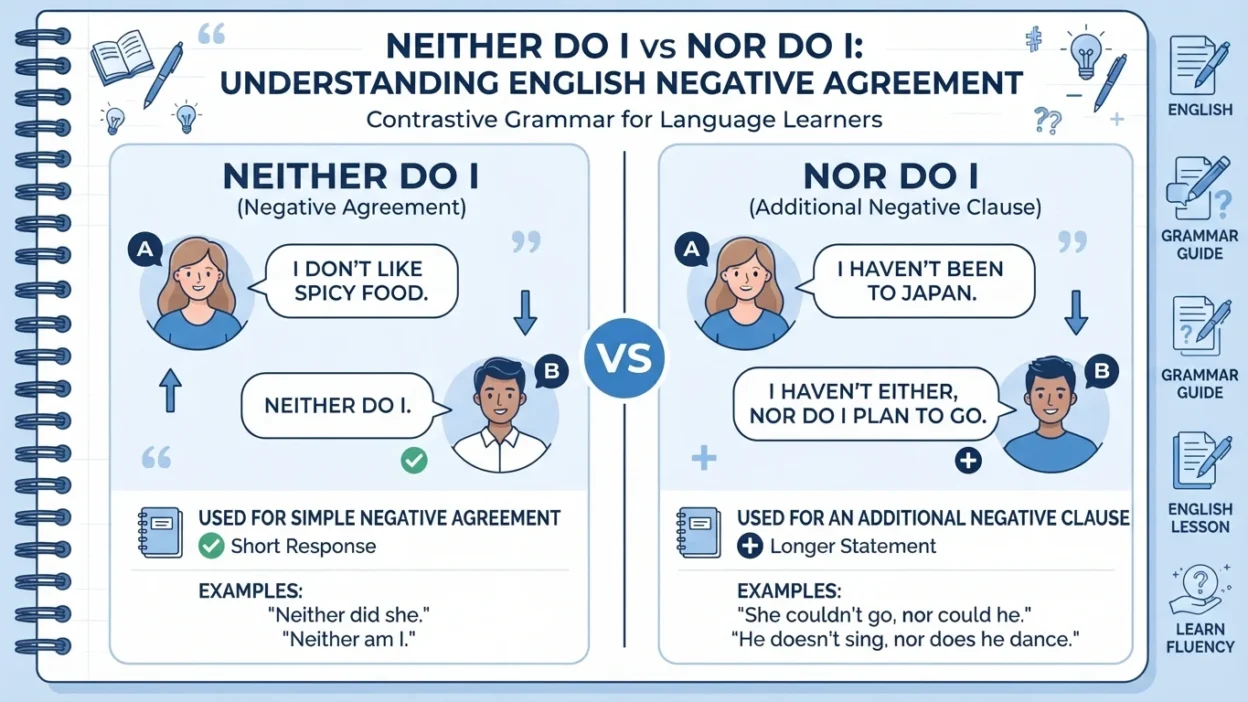
If you have ever paused before replying “neither do I” or “nor do I,” you are dealing with a very common English grammar question. Both expressions are connected with negative statements, and both can communicate that something is also true for you. However, they are not always interchangeable. The difference becomes much clearer when you look at how each expression functions inside a sentence.
In everyday English, “neither do I” is usually the more natural choice when you are simply agreeing with someone’s negative statement. “Nor do I” is commonly used to introduce an additional negative idea, especially after another negative clause. This guide explains neither do I vs nor do I with simple rules, real-life examples, sentence patterns, common mistakes, and useful alternatives. By the end, you will know which expression sounds natural in both conversation and formal writing.
Quick Answer
“Neither do I” usually means “I don’t either” and is commonly used to agree with a negative statement. “Nor do I” can also express negative agreement, but it more often connects an additional negative clause. In everyday conversation, “neither do I” is generally more natural.
Why People Confuse It
The confusion comes from the similar meanings of neither and nor.
Both are associated with negative ideas:
- Neither can mean “also not.”
- Nor can mean “and not” or introduce another negative statement.
- Both can be followed by an auxiliary verb and subject.
For example:
“I don’t like coffee.”
“Neither do I.”
But:
“I don’t like coffee, nor do I like tea.”
The first sentence uses neither to agree. The second uses nor to connect two negative ideas.
Another reason for confusion is subject-auxiliary inversion. Instead of saying “Neither I do,” standard English says “Neither do I.”
First Word: Neither Do I
Neither do I is a negative agreement expression. It means:
I don’t either.
It is normally used after someone has said something negative.
Example
“I don’t watch football.”
“Neither do I.”
The speaker is saying that they also do not watch football.
The basic structure is:
Neither + auxiliary verb + subject
Examples:
- Neither do I
- Neither can I
- Neither am I
- Neither have I
- Neither will I
- Neither did I
The auxiliary verb depends on the original statement.
Compare:
“I can’t swim.”
“Neither can I.”
“I’m not hungry.”
“Neither am I.”
“I haven’t finished.”
“Neither have I.”
So, “neither do I” is not always literally the correct form. The auxiliary must match the grammar of the original sentence.
Second Word: Nor Do I
Nor do I is also used with negative ideas, but its most common role is to add another negative clause.
For example:
“I don’t like coffee, nor do I like tea.”
Here, nor connects two negative ideas:
- I don’t like coffee.
- I don’t like tea.
It can also appear as a short response:
“I don’t understand this.”
“Nor do I.”
That is grammatically possible, but in ordinary conversation, “Neither do I” or “I don’t either” will often sound more natural.
The structure is:
Nor + auxiliary verb + subject
For example:
- Nor do I
- Nor did I
- Nor can I
- Nor have I
- Nor am I
- Nor will I
Comparison Table
| Feature | Neither Do I | Nor Do I |
|---|---|---|
| Basic meaning | I don’t either | I also don’t / and I don’t |
| Main function | Negative agreement | Adds another negative idea |
| Common position | Often a short response | Often connects clauses |
| Tone | Natural and neutral | Can sound more formal |
| Example | “I don’t sing.” “Neither do I.” | “I don’t sing, nor do I dance.” |
| Common alternative | “I don’t either.” | “And I don’t either.” |
When to Use Each
Use “Neither Do I” for Agreement
If someone says:
“I don’t like spicy food.”
You can naturally respond:
“Neither do I.”
This is probably the easiest rule to remember.
Use it when the meaning is:
“That negative statement is true for me too.”
Use “Nor Do I” to Add a Negative Clause
When you already have a negative statement and want to introduce another negative idea, nor works well.
“I don’t like coffee, nor do I drink tea.”
This is especially common in formal or carefully written English.
What about casual conversation?
In everyday speech, you might hear:
“I don’t like coffee.”
“Me neither.”
or:
“I don’t like coffee.”
“I don’t either.”
These are very natural alternatives to “Neither do I.”
Examples: Neither Do I vs Nor Do I
Examples with “Neither Do I”
1.
“I don’t like horror movies.”
“Neither do I.”
2.
“I don’t eat seafood.”
“Neither do I.”
3.
“I can’t drive.”
“Neither can I.”
4.
“I’m not ready yet.”
“Neither am I.”
5.
“I haven’t finished my homework.”
“Neither have I.”
6.
“I won’t go to the party.”
“Neither will I.”
Examples with “Nor Do I”
7.
“I don’t drink coffee, nor do I drink tea.”
8.
“I don’t play tennis, nor do I play basketball.”
9.
“I didn’t call him, nor did I send him a message.”
10.
“I don’t understand the question, nor do I know the answer.”
11.
“I have never been to London, nor have I visited Manchester.”
12.
“I wasn’t invited, nor was I told about the event.”
These examples show an important pattern: nor is followed by inversion.
Instead of:
“Nor I do…”
standard English uses:
“Nor do I…”
Common Mistakes
Mistake 1: “Neither I do”
❌ Neither I do.
✅ Neither do I.
English uses inversion after neither in this construction.
Mistake 2: “Nor I do”
❌ I don’t like coffee, nor I do like tea.
✅ I don’t like coffee, nor do I like tea.
Mistake 3: Using “neither” after a positive statement
❌
“I love chocolate.”
“Neither do I.”
If you agree with a positive statement, use so:
✅
“I love chocolate.”
“So do I.”
Mistake 4: Choosing the wrong auxiliary
Consider:
“I can’t swim.”
The correct response is:
“Neither can I.”
Not:
❌ “Neither do I.”
The auxiliary verb should match the original sentence.
Mistake 5: Double negatives
Avoid constructions such as:
❌ “I don’t like it neither.”
In standard English, use:
✅ “I don’t like it either.”
or:
✅ “Neither do I.”
Memory Trick
Here is an easy way to remember the difference:
Neither = “Me too, but negative.”
“I don’t like it.”
“Neither do I.”
Nor = “Another negative.”
“I don’t like it, nor do I want it.”
And remember:
PRECISE SHORTCUT:
Neither → agreement
Nor → additional negative
This isn’t a rule that covers every possible sentence, but it is an excellent shortcut for everyday English.
American vs British English
Both American English and British English use “neither do I” and “nor do I.” There is no major difference in their basic grammar or meaning.
However, “neither do I” tends to feel very natural in everyday conversation in both varieties:
“I don’t like this movie.”
“Neither do I.”
Nor can sometimes sound more formal or literary, particularly when connecting clauses:
“I don’t agree with the decision, nor do I support the proposal.”
In casual conversation, speakers may choose:
“I don’t either.”
or:
“Me neither.”
Similar Words
Several expressions are closely related to neither do I.
I Don’t Either
This is one of the most natural alternatives:
“I don’t like coffee.”
“I don’t either.”
Me Neither
Me neither is common in informal conversation:
“I don’t watch sports.”
“Me neither.”
It is conversational rather than formal.
So Do I
Be careful with so do I because it normally agrees with a positive statement:
“I like pizza.”
“So do I.”
Compare:
“I don’t like pizza.”
“Neither do I.”
Neither Am I
Use this when the original sentence uses am:
“I’m not tired.”
“Neither am I.”
Neither Can I
Use this when the original sentence uses can:
“I can’t swim.”
“Neither can I.”
FAQs
1. Which is more natural: “neither do I” or “nor do I”?
“Neither do I” is generally more natural as a short response to a negative statement. “Nor do I” is especially useful when adding another negative clause.
2. Can I say “nor do I” by itself?
Yes. For example:
“I don’t know the answer.”
“Nor do I.”
However, “Neither do I” may sound more natural in casual conversation.
3. Does “neither do I” mean “I don’t either”?
Yes. They have essentially the same meaning.
“I don’t like tea.”
“Neither do I.”
“I don’t either.”
4. Is “neither do I” grammatically correct?
Yes. It is a standard English construction used to agree with a negative statement.
5. What is the difference between “neither” and “nor”?
Neither commonly expresses negative agreement or works in the pair neither…nor. Nor can introduce another negative clause.
6. Can I say “me neither”?
Yes. “Me neither” is very common in informal spoken English.
7. What should I use in formal writing?
For formal writing, choose the expression that fits the sentence structure. “Neither do I” is perfectly grammatical, while “nor” is useful for connecting negative clauses.
Final Verdict
When deciding between “neither do I” and “nor do I,” first look at what you are trying to say. If someone makes a negative statement and you simply want to say “I don’t either,” choose “neither do I.” It is clear, natural, and widely used.
If you are connecting another negative idea to an existing negative clause, “nor do I” is often the better choice. Remember that both expressions use inversion, so the auxiliary verb comes before I: “neither do I,” “nor do I,” “neither can I,” and so on.
Conclusion
The difference between neither do I vs nor do I is mostly about sentence function. “Neither do I” is commonly used for negative agreement, while “nor do I” frequently connects an additional negative clause. Once you recognize whether you are responding to someone or adding another negative idea, the choice becomes much easier.
For everyday English, keep this simple pattern in mind: “I don’t…” → “Neither do I.” When you want to add another negative idea, think “nor.” With these patterns, you can avoid common grammar mistakes and make your English sound more natural and confident.
Remember This
Neither do I = I don’t either.
Nor do I = another negative idea, often connected to a previous negative clause.
“I don’t like coffee.” → Neither do I.
“I don’t like coffee, nor do I like tea.” → Nor do I…

Baylor Wylder is a culture and lifestyle blogger with a modern frontier perspective.
He writes about creativity, independence, and building a life with purpose.
His work blends reflection, ambition, and contemporary style.