
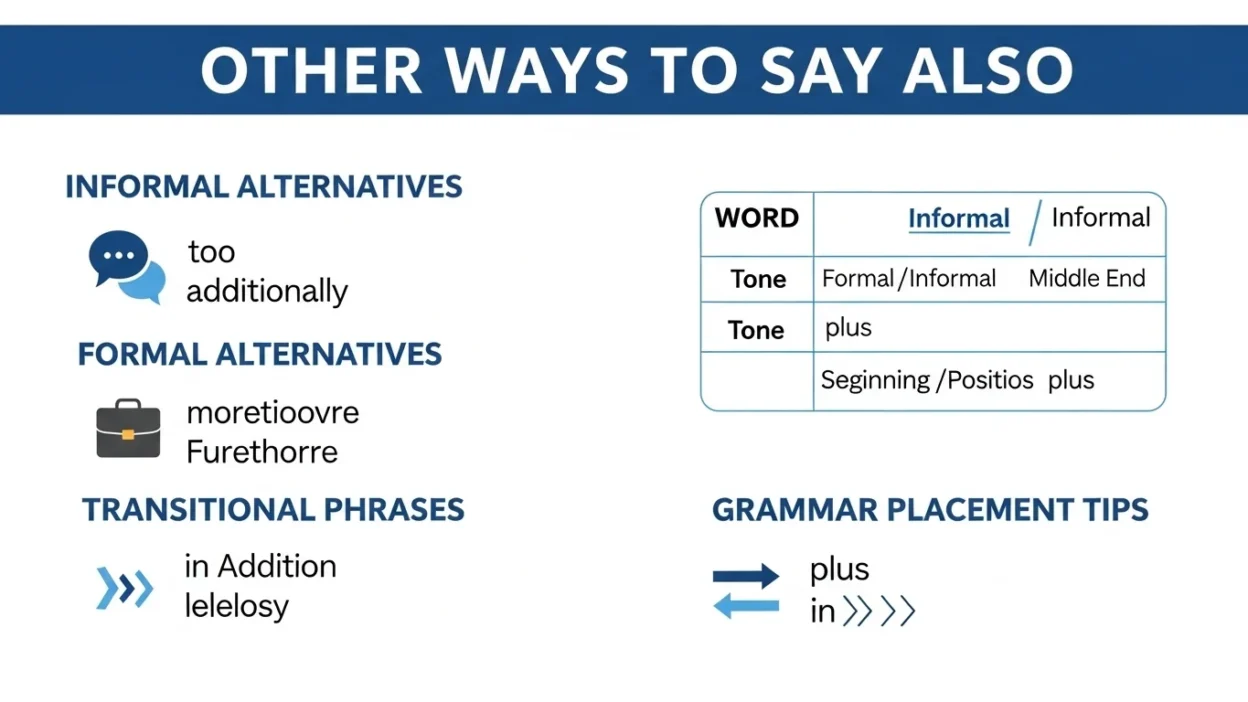
The word also is one of the most frequently used transition words in English. While it’s simple and effective, relying on it too often can make your writing sound repetitive or basic.
Whether you’re writing an academic paper, professional email, blog post, or business report, knowing other ways to say also helps you sound more polished and precise.
Strong writing depends on variety, clarity, and tone control. By expanding your vocabulary, you can express addition, agreement, similarity, or emphasis more effectively. This guide will show you better alternatives to also, explain when to use them, and help you avoid common grammar mistakes.
Quick Answer: What Are Other Ways to Say Also?
Other ways to say also include too, as well, additionally, moreover, furthermore, besides, in addition, likewise, and plus. The best choice depends on tone, sentence placement, and context.
1. Common Everyday Alternatives to “Also”
These are natural, conversational substitutes used in daily communication.
1. Too
Meaning: In addition; as well
Usage Rule: Usually placed at the end of a sentence.
Example: I enjoyed the movie, and my sister did too.
Notes: Avoid placing “too” mid-sentence unless emphasizing.
2. As Well
Meaning: In addition; also
Usage Rule: Typically comes at the end of a clause.
Example: She speaks Spanish and French as well.
Notes: Slightly more formal than “too.”
3. Plus
Meaning: Additionally; furthermore
Usage Rule: Common in informal speech.
Example: It’s affordable, plus it’s easy to use.
Notes: Avoid in formal academic writing.
4. Besides
Meaning: In addition to; apart from
Usage Rule: Often starts a sentence or clause.
Example: Besides being efficient, the software is affordable.
Notes: Can imply “in addition to what was mentioned.”
5. Likewise
Meaning: In the same way
Usage Rule: Used to show similarity.
Example: She enjoys hiking; likewise, her brother loves camping.
Notes: Best for comparisons.
6. Along With
Meaning: Together with
Usage Rule: Used before nouns.
Example: She submitted the report along with the budget sheet.
Notes: Not always interchangeable with “also.”
7. And
Meaning: Used to connect ideas
Usage Rule: Connects words, phrases, or clauses.
Example: He plays the guitar and sings.
Notes: Simplest alternative but not always stylistically strong.
2. Formal Alternatives to “Also”
Ideal for academic, business, and professional writing.
1. Additionally
Meaning: In addition
Usage Rule: Often used at the beginning of sentences.
Example: Additionally, the study confirms earlier findings.
Notes: Strong academic tone.
2. Moreover
Meaning: Furthermore; besides
Usage Rule: Introduces supporting information.
Example: The plan is cost-effective. Moreover, it saves time.
Notes: Adds emphasis.
3. Furthermore
Meaning: In addition to what has been said
Usage Rule: Formal transitions in essays.
Example: Furthermore, the data supports our hypothesis.
Notes: Avoid overuse.
4. In Addition
Meaning: Also; besides
Usage Rule: Common at the beginning of sentences.
Example: In addition, we must consider budget constraints.
Notes: Neutral tone.
5. Not Only… But Also
Meaning: Adds emphasis
Usage Rule: Parallel structure required.
Example: She is not only intelligent but also hardworking.
Notes: Ensure grammatical balance.
6. As Well As
Meaning: In addition to
Usage Rule: Links two elements.
Example: The package includes installation as well as support.
Notes: Verb agrees with first subject.
7. Coupled With
Meaning: Combined with
Usage Rule: Often used in analysis writing.
Example: Strong leadership, coupled with innovation, drives growth.
Notes: More advanced tone.
3. Transitional Phrases That Replace “Also”
Used to improve flow between paragraphs and ideas.
1. What’s More
Meaning: Additionally
Usage Rule: Informal transition.
Example: The service is affordable. What’s more, it’s reliable.
Notes: Conversational tone.
2. On Top of That
Meaning: In addition
Usage Rule: Informal speech.
Example: It’s raining, and on top of that, we forgot umbrellas.
Notes: Avoid in formal writing.
3. Similarly
Meaning: In a similar way
Usage Rule: Shows comparison.
Example: The first study showed improvement. Similarly, the second study confirmed it.
Notes: Use when comparing ideas.
4. Equally
Meaning: To the same degree
Usage Rule: Used for balanced emphasis.
Example: Customer satisfaction is equally important.
Notes: Not always interchangeable.
5. By the Same Token
Meaning: In the same way
Usage Rule: Formal comparison.
Example: The product is affordable. By the same token, it’s durable.
Notes: Rare but powerful.
6. Another Key Point
Meaning: Introduces an additional idea
Usage Rule: Structured writing.
Example: Another key point is user accessibility.
Notes: Good for presentations.
7. To Add To This
Meaning: In addition
Usage Rule: Used in discussion writing.
Example: To add to this, we must examine the risks.
Notes: Transitional phrase.
4. Context-Based Alternatives (Depending on Meaning)
Sometimes “also” expresses similarity, reinforcement, or inclusion.
1. Too (Agreement)
I agree with you. I think so too.
2. As Well (Afterthought Addition)
He ordered dessert as well.
3. In the Same Way
She teaches with passion. In the same way, her mentor inspired students.
4. Not to Mention
The house is spacious, not to mention affordable.
5. Even
She also finished early → She even finished early (stronger emphasis).
6. Including
Several countries, including Canada, participated.
7. Together With
The CEO, together with the board, approved the plan.
5. Placement & Grammar Rules Table (Updated)
| Synonym/Phrase | Sentence Position | Tone/Formality | Example Sentence |
|---|---|---|---|
| Too | End | Informal | I want to come too. |
| As well | End | Neutral | She bought snacks as well. |
| Additionally | Beginning | Formal | Additionally, we must review costs. |
| Moreover | Beginning | Formal | Moreover, profits increased. |
| Furthermore | Beginning | Very Formal | Furthermore, research supports this. |
| Besides | Beginning/Middle | Neutral | Besides, we have no time. |
| In addition | Beginning | Formal | In addition, safety matters. |
| Plus | Middle | Informal | It’s cheap, plus it’s durable. |
| Not only… but also | Middle | Formal | She is not only smart but also kind. |
| As well as | Middle | Formal | He plays piano as well as violin. |
Common Mistakes When Replacing “Also”
1. Overusing Formal Transitions
Using furthermore in casual emails sounds unnatural.
2. Misplacing “Too”
Incorrect: Too I want coffee.
Correct: I want coffee too.
3. Breaking Parallel Structure
Incorrect: She is not only talented but also works hard.
Correct: She is not only talented but also hardworking.
4. Using “As Well As” Like “And”
Incorrect: John as well as Mike are coming.
Correct: John as well as Mike is coming.
5. Adding Redundant Transitions
Avoid: Additionally, also, we need approval.
Practical Example Paragraphs
Basic Version (Repetitive):
The software is affordable. It is also user-friendly. It also offers customer support. It is also secure.
Improved Version:
The software is affordable. Additionally, it is user-friendly and offers dedicated customer support. Moreover, its advanced encryption ensures maximum security.
FAQs About Other Ways to Say Also
1. What is the most formal synonym for “also”?
“Furthermore” and “moreover” are considered highly formal.
2. Is “too” grammatically correct?
Yes, when placed correctly, usually at the end of a sentence.
3. Can I start a sentence with “also”?
Yes, but it’s often better to use “additionally” or “in addition” in formal writing.
4. Is “plus” appropriate in professional writing?
Generally no; it’s better suited for informal contexts.
5. What’s the difference between “as well as” and “and”?
“As well as” emphasizes the first item and does not create compound subject agreement like “and.”
Final Thoughts
Expanding your vocabulary beyond the word also improves clarity, professionalism, and flow. The right alternative depends on tone, sentence placement, and writing context.
By understanding grammar rules and usage differences, you can write with greater precision and authority. Whether you’re crafting academic essays, business reports, or everyday messages, choosing the correct synonym strengthens your communication and enhances readability.

Miller Rhodes is an American nonfiction writer focused on personal growth and modern entrepreneurship.
His work blends thoughtful analysis with practical strategies for navigating today’s digital world.
He writes to help readers think clearer, act smarter, and build meaningful success.